Showing posts with label MARKETING MANAGMENT. Show all posts

Sunday, January 29, 2012

Analysis of E-Commerce in Middle East & North Africa - Part 1


Introduction
Fig 1: Insights MENA photo, a website which specializes in studying internet consumption in MENA region. Source: http://www.insightsmena.com/ en/   

Internet and the digital world have become an integral part of daily life for a large number of people across the globe. For many, a considerable amount of time daily spends on the web. The digital world is also making strong inroads in the commercial space. According to a survey conducted by “Neilson”, 875 million individuals have purchased online, at least once a year. According to “world internet statistics”, as on 2011, Middle East constitutes only 3.4 percentages of the global users and hence does not contribute much on the e-commerce front. (If North African countries be included, the percentage will go a bit higher). Even though it does not play a very big role so far, e-commerce seems to have a great potential in the near future. The future growth could be fuelled by-high economic growth, young demographics, investments in the ICT infrastructure and political transition. Keeping this in mind, “Management Guru Blog”, will do a comprehensive analysis of the overall e-commerce industry in the MENA region. The entire report will be produced in a series, delving into the various aspects of e-commerce in the region. The very first in the series, will a give a brief description of the internet consumption as well as e-commerce activities in the region.        

E-commerce Statistics for Middle East & North Africa (mena)


Table 1: shows the GNI per capita and internet penetration in some selected MENA countries. Source: World Bank.

                    Table 2: Shows, mobile internet usage, in terms of percentage. Source: Insights MENA


Fig 1: shows the average weekly internet consumption by internet users (non internet users are not included in this), in minutes for the entire MENA region as well as for selected economies. The total internet consumption is the sum total of average weekly access via laptop/desktop and mobile. Source: Insights MENA


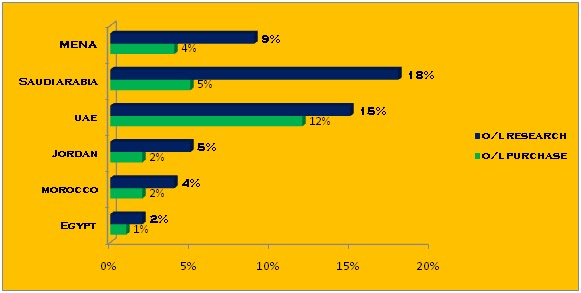
Fig 2: shows the percentages of online research and purchases made, across the overall population (includes internet users as well as non users), for MENA region and some selected economies. Source: Insights MENA. 


Fig 3: shows the percentage of internet users, who always pay attention to online ads while surfing the web, for MENA as well as other individual economies. Source: MENA Insights.


Table 3: shows the average weekly frequency, of some selected online activities, for internet users of MENA region and some individual economies of the region. Source: Insights MENA


Analysis

Some of the key findings of the statistics are as follows:

·         High per capita income influences high e-commerce activities: Countries like UAE and Saudi Arabia have fared well than their other Arab counterparts, on account of high per capita income. High per capita income results in high penetration of- internet, internet enabled better quality handsets, credit cards etc. This eventually has resulted in high percentages of E-commerce research and purchase activities, in these countries.

·         Unique case of Saudi Arabia: Saudi Arabia, the largest MENA economy, enjoys a comparatively high internet penetration and internet enabled mobile usage of, 41 and 54, percentages respectively. It has a very high online research percentage of 18 and  42 percentages of internet users claim to always pay attention to online advertisements. In spite of having strong arsenals, the overall percentages of e-commerce stands at moderate five percentages, just one percentage point higher than the overall MENA average of four. It seems, cash based culture and low reliance on credit cards, coupled with under performance in the 45 plus segment, has deterred Saudi Arabia from realizing its full e-commerce potential.


·         Jordan has huge e-commerce potential: Jordan offers another good case to study. Unlike gulf countries, it does not have any natural oil resources of its own and according to “World Bank” is considered as a developing nation with moderate per capita GNI of US $ 5,790. But, the tiny Levant state is also among one of the most innovative Middle Eastern countries and in the recent years have taken strides in the areas of, innovation and technology adoption. It enjoys decent; internet penetration, average weekly internet consumption and outlook towards e-commerce. A close look to some of the online activities of an average Jordanian internet user provides lot of interesting insights. An average user clicks an online ad, some 5.93 times a week and spends considerable time in research also. But when it comes to buying a product online, seems he hardly engages himself.  It might be due to the same factors preventing other countries as well- cash based culture, low credit card penetration and apprehension of using the internet for making payments. Jordan can be considered as one of the huge potential market for e-commerce in the region. With higher credit card/debit card penetration and education campaigns, higher e-commerce percentages could be realized in near future.
 

Saturday, June 4, 2011

Etisalat : Strategic Analysis

                                      Fig 1: Etisalat Logo ( source : PTCL worker.com)
                                                   
 The given blog is exclusively dedicated to the telecomm giant from Middle East, UAE based Etisalat. Etisalat is among, one of the non oil sector based success stories from the Gulf and the given blog will do a detailed analysis for it. This will consist of the basic introduction followed by the overall telecomm market in UAE. In the next part the growth and expansion of various businesses of Etisalat over the last decade will be studied,  followed by some of the major international subsidies of Etisalat. In the concluding part the future strategies of Etisalat will be analyzed. Once the blog will be done, another blog, dealing with the financials of Etisalat will be rolled out soon.

Introduction

Emirates Telecommunication Corporation, branded as Etisalat is one of the major telecommunication companies in the world, operating across Middle East, Asia and Africa. It provides mobile and fixed line data and voice services to individuals, enterprises, telecomm companies etc. It also provides a wide range of high tech and complimentary services to telecomm companies including SIM card manufacturing, payment solutions, staff training, peering, voice and data transit, sub marine and land cable services. (Etisalat.ae, 2011)


The company was founded in 1976 as a joint venture between International Aeradio limited, a British company and local partners. Later on in 1983, the govt. of UAE had a 60% stake in the company and rest was publicly traded. From 36,000 exchange lines in 1976, it was having around 7, 47,000 lines in 1998. Today Etisalat is considered as one of the biggest success sagas in Middle East and is one of the biggest contributors to the UAE government after the traditional oil sector. Currently operating in 18 nations world wide, it enjoys around 135 Million aggregate subscribers and annual revenue of US $ 8.7 billion. (Etisalat Annual report, 2010)

Table 1:  various companies of the overall Etisalat group


Fig 2: shows breakdown of revenue (as on Dec, 2010) (Source: Etisalat annual report 2010)


Fig 3: shows the breakdown of Etisalat group as on Dec, 2009 (source: Etisalat annual report 2009)

Telecommunication sector in UAE:-


The growth of telecommunication sector at UAE had been synonymous with the growth of Etisalat, its major telecommunication company. The telecom sector in UAE had been highly regulated with Etisalat having monopoly in the market for most of the time. In spite of having monopoly like many of its other Emirati counterparts, Etisalat had always been upfront in coming up with newer technologies and value based innovation in the market. By 2005 mobile penetration was more than 100 % where as internet and broad band penetration was more than 60 %. The market dynamics changed in 2006 with the emergence of Du, another telecomm company in the market. (2dayDubai.com, 2009) Du is owned- 40 % by Dubai government, 20% by Mubadala, 20% by TECOM (Dubai technology and commerce free zone) and rest 20 % is owned through publicly listed shares in Dubai financial market. Presently due to saturation as well as competition the top line of the Etisalat, the major telecomm company seems to be affected in UAE, but it is growing rapidly through international expansion and acquisitions of other players. Moreover the overall ICT sector of UAE (consisting of IT along with telecom) is poised for a strong growth in the coming time. Both the major Emirates of UAE- Dubai as well as Abu Dhabi have ambitious growth plans in the form of Dubai 2015 and Abu Dhabi 2030 respectively and they realize the fact that strong ICT sector is a precondition for achieving these ambitious plans. The ICT sector is expected to get strong boost due to multibillion dollar infrastructure development plans, economic diversification and an exuberant SME segment, in the nearby future.


Growth of Etisalat over the last ten years


From a humble beginning in 1976, Etisalat has grown into a giant organization. According to financial times it holds 140th position among the top 500 companies, in terms of market capitalization. By the mid of 2000 Etisalat had evolved  from a local player that provided basic wire line and data services to an international player providing a wide range of sophisticated services. The given section will discuss the growth track of Etisalat


Fig 8: showing the revenue and net profit of Etisalat, over the last eight years, Source: (Annual Reports 2002, 2005 and 2010)


                      Fig 5: Annual Etisalat mobile subscriber in UAE, over the last ten years (Source: Annual Report 2002, 2004 and 2010)


Key Insights from fig 4:-


• The CAGR (compound annual growth rate) for mobile subscribers , for the  period of last 10 years  is 18.5%

• The CAGR for 2000-05 is 26.1%, whereas for 2005-10 is 11.4%.

• There has not been any substantial growth in the last three years.


Fig 6: Annual Etisalat fixed line subscriber in UAE, over the last ten years (Source : Annual Report 2002, 2005, 2010)
Key Insights from fig 5:


• The CAGR for number of fixed line subscribers over the  period of last 10 years is very modest at 1.97 %.

• The CAGR for the period 2000-05 is 4 % whereas for 2005-10, there had not been any substantial growth

• The overall fixed line market for Etisalat UAE had reduced in the last two years.


              Fig 7: shows the total number of internet subscribers in UAE over the last 10 years, Source( Annual Report 2002, 2005 and 2010)

Key Insights:Etihad Etisalat:


• The CAGR of internet subscribers for Etisalat UAE, over the period of last 10 years is 20.2 %

• The CAGR for 2000-05 is 20.3%, whereas for 2005-10 is 20 %.

• After showing substantial year on year growth for the 1st nine years, the market has taken a dip in the last year.

Fig 8: shows the national as well as international calls in billion minutes, over the last ten years, Source ( Annual Report 2002, 2005, 2010)  

Key Insights:


• The CAGR for, national calls is 10.5 %, international calls is 11.9 %, over the last 10 years.

• The CAGR during 2000-05, for national calls is 18.2% and for international calls is 25.31 %. The CAGR during 2005-10, for national calls is 3.3 % and for international calls is 0 %.

• Both national as well as international calls have taken dip in the last two years.

General Insights:

After studying all the above graphs two important trends are emerging:-

• Etisalat has shown strong growth in all the sections during 2000-05, compared to 2005-10.

• In every section, the market is reducing down for Etisalat in UAE in the last couple of years, owing to saturation (In 2008 penetration in the mobile market had already reached 190 %, hence providing less scope for further expansion), competition by DU and global economic slowdown.

Global Expansion:


Etisalat operates across 18 nations in the Middle East, Africa and Asia. It is one of the fastest emerging global telecomm brands, primarily identifying underserved markets and targeting them with high quality, value based innovative services. The international expansion strategy for Etisalat consists of both, having fully owned subsidies as well as having majority and minority stake in various existing local telecom companies. In its tryst with inorganic growth and expansion, Etisalat had so far got commendable success. It is known for entering aggressivley into new markets and expanding the subscriber base very quickly. The following part will  discuss some of the Geographical success stories of Etisalat.


Etisalat Misr


Etisalat entered into Egypt (also called Misr in Arabic) in 2006, as 3rd mobile service provider in the country. Within 50 days of its launch it captured a base of one million subscribers, which had increased to around 10 million by today. Etisalat’s 2G network covers around 98 % of population while 3G network covers around 73 % of the population. (Etisalat.ae, 2011)
Atlantique Telecom, Moov

Atlantique Telecom (AT) operates in seven countries across West Africa. Etisalat initially had a 50 % stake in AT, which  increased over a period of time and eventually by February 2010, it has  full ownership of AT. Though all the seven nations are different in their socio economic cum political outlook but Moov, the common brand name for AT across the region, enjoys a very strong brand value. The region which is underserved with a low penetration presents a very strong potential for future growth. AT has a coverage of 54 % in the region.

Etisalat Nigeria

Nigeria, the most populous African state with 22 % mobile penetration is high up on Etisalat’s agenda of international expansion. Etisalat entered into the Nigerian market in October 2008 and known for its aggressive early movements, captured one million subscribers by June. By September 2011 it was having a subscriber base of 5 million. Etisalat is known in Nigeria for its top quality service and within year of its launch had been credited with the best service provider by the national telecom regulatory authority, Nigerian Communication Commission (NCC). Currently Etisalat is active across all the 36 states in Nigeria and has coverage of 73 %.

                  Fig 9: Growth of subscriber base of Etisalat Nigeria, source: (www.itp.net)


Etihad Etisalat (also branded as Mobily) is the second mobile service provider in the kingdom of Saudi Arabia after Saudi Telecom. It entered into Saudi Arabia in May 2005, after winning the bid for second GSM license. Mobily was one of the fastest growing GSM service providers in Middle East and North Africa and captured 3.8 Million subscribers, just within a year of its launch. Presently it has more than 17 million subscribers. Etisalat’s GSM service covers almost 97 % of the populated areas where as the 3.75 G service covers 80 % of the populated areas in Saudi Arabia. Etisalat has a 27 % share in Mobily where as 45 % are with six local partners, rest are publicly traded. (Etisalat.ae, 2011)


Pakistan Telecommunication Public Limited (PTCL)

Founded in 1947, Pakistan Telecommunication Public limited or PTCL is the largest telecomm service provider in Pakistan. In 2006, the Pakistan govt. sold 26% stake to Etisalat. 62 % is retained by the govt. whereas the rest 12 % is publicly traded.


Future Strategy


Etisalat is truly a global brand, with operations spread across 18 nations all over the globe. The future of Etisalat depends how well it expands in to various new geographies and technologies along with the kind of value based innovation it brings into the existing portfolios of geographies and product. Though a considerable part of revenue will come from the UAE, but due to intensifying competition and saturation of the market, maintaining a healthy top line from UAE will not be very easy. Following factors can play important role in deciding the future strategy for Etisalat: -


• New Markets: - newer markets like India and Sri Lanka will play a crucial role in influencing future strategy of Etisalat. Many of the existing markets like Pakistan, Sudan Tanzania and Waste Africa are still underserved and have huge future growth potential. Take for instance Sudan where fixed line penetration is just 1-2 %, and hence offers a great growth potential for telecom majors like Etisalat. Similarly India a nation with a population 115 Million and a penetration of 43 % provides strong growth opportunities. Though competition is quite intense in India with 12 players fighting for their share of pie, the sheer size of Indian market can deliver profitability to many of the competent players at the same time. Similarly in Africa, where many  nations are expected to achieve strong economic growth , the mobile, internet and fixed line penetrations are expected to shoot up, thereby providing a strong growth potential. Along with the existing markets, Etisalat needs , continue searching for newer underserved markets, and devise strategies for them.

Table 2 : calculates the future market potential for Etisalat


Future Growth of UAE: - UAE has strong future growth plans in the form of Dubai 2015 and Abu Dhabi 2029. UAE no more wants to be solely dependent on petroleum for its revenue and aims at diversify into various alternate industries such as ICT, High tech, defense, tourism, trade, media, SME segment etc. Currently these sectors are seeking huge capital investment and the expected future growth will influence Etisalat’s business in a positive way.


Innovative products for local markets:- Like any other globalized company, Etisalat needs to understand the dynamics of the local market and  come up with innovative solutions, customized for the local markets. One very good example can be the partnership between Etisalat Afghanistan and PTCL, which offered attractive rates between the two countries, resulting in quadrupling of traffic since the launch in 2010.  Etisalat needs to roll out such  innovative customized packages to lure more customers.


Content generation and monetization of mobile content: is an area, which can have future growth potential for Etisalat. (Comm.com, 2011)


Newer technologies: - The top management at Etisalat believes “Cloud Computing” as a deeply transformational trend worldwide, and  is planning to launch a wide range of service in this field in the near time. Another area that provides a great future potential is M2M (Machine to Machine) technologies. Etisalat is attempting to develop industry specific solutions in the given field. M2M technology holds a great future potential. According to research done by Research Infonetics in 2009 there were 87 million mobile embedded M2M connections, which are forecast to rise to 428 million by 2014, a compound annual growth rate (CAGR) of 38 %. (Comm.com, 2011)


# Un Served present market size= population * Coverage * (100 – Penetration) * Etisalat’s stake

Reference  

1> Etisalat.ae, 2011, company website, about us: corporate profile,


2> Etisalat annual report, 2010, p-3,


3> 2dayDubai.com, 2009, United Arab Emirates ICT sector and Dubai’s knowledge economy, available at < http://www.2daydubai.com/pages/dubai-ict-sector.php>


4> Etisalat.ae, 2011, Etisalat Misr, Etisalat.ae, 2011, Etisalat Etihad ‘ Mobily’ Saudi Arabia,


5> Comm.com, 2011, Seizing the moment, available at< C:\Documents and Settings\Administrator\Desktop\etisalat vs Du\Seizing the moment Comm_ Decisive coverage of telecommunications strategy.mht >


6> Comm.com, 2011, Seizing the moment, available at < C:\Documents and Settings\Administrator\Desktop\etisalat vs Du\Seizing the moment Comm_ Decisive coverage of telecommunications strategy.mht >
.

Saturday, April 23, 2011

Egypt VS Turkey: as tourist destinations


In the following blog the author will attempt  doing a comparative analysis of the two biggest tourist destinations from the Mediterranean region, Egypt and Turkey, with the help of qualitative as well as quantitative frameworks. Both Egypt and Turkey are world famous tourist destinations sharing lot of similarities across religious, cultural social and economical parameters.


Profiles as tourist destination


Egypt: Egypt, also known as the cradle of civilization has a very strong and vibrant tourism industry, employing 12% of the work force and receiving around 125 Million tourists every year (Dinar Standard, 2011). It has a wide range of tourist avenues such as Pyramids, Sphinx and other magnificent monuments; exotic desserts, wild life parks and sea beaches; shopping complexes and other life style centers and state of the art golf courses; providing a wide range of activities such as sight seeing, dessert safaris, golf tourism, cultural tourism, sea activities, cruising, adventure sports etc. (Egypt. travel, 2011)


Turkey: Turkey also has a  very rich history and cultural heritage and is  melting pot of various civilizations such as European, Arabic and Central Asian. Like Egypt it also has a wide range of tourist avenues such as; beautiful cities like Istanbul, Antalya, Ankara etc; rugged landscapes, serene and calm sea beaches and coastlines, full of exotic floras and faunas; plethora of heritage sites, museums, monuments and archeological sites etc. The range of activities at Turkey includes site seeing, adventure sports, winter sports, golf, rafting, eco tourism, yachting, night life, cultural tourism, shopping, Turkish bath, cuisines, conventions, wild life adventures etc. (tourismturkey. org, 2011)


Following table  shows the demographic and economic Indicators for 2010 (Euromonitor, 2011):


The following figure compares the GDP growth rate of both, Egypt and Turkey, #


Social Indicators of Egypt and Turkey (Source: UNICEF)


comparison of Egypt and Turkey on some selected social parameters


Tourism industry in Egypt and Turkey


Egypt


Since ancient time Egypt has been a very popular tourist destination, attracting large number of tourists from Europe, Middle East and Africa. In 19th century after Napoleon's invasion,  people once again got interested in Egypt. The new era of tourism in Egypt began in 1989-90, when many of the leading hotels were privatized, airline sector was liberalized and the Egyptian govt. came up with some strong marketing campaigns. Since then the industry has been moving with an accelerating pace, occasionally hit hard by terrorism and political unrest. Last year out of the 125 Million tourists it had received, Russia with 14 % had the highest share, followed by United Kingdom, Germany and Italy. Though presently due to the political unrest the tourism industry had been affected, but in the long run it is expected to grow further, owing to expected political stability and transparency as well as more inflow of tourists from emerging economies like China and India.


The following histogram shows the growth of tourism industry since 1989-90, for Egypt

The following figure shows growth of annual revenue from tourism, over the period of   years,
 

The following pie chart shows the percentage of 10 major countries, exporting tourist to Egypt, in the year 2007 (values given in 000s)
 
Source of data: (Information development support center)
 
Egypt is primarily known for cultural tourism. Having large number of Pharaonic, Roman, Coptic and Islamic monuments and archaeological sites, it’s a paradise for culture tourists coming from various parts of the globe. Though position of cultural tourism is unparalleled, Egypt had also made huge investments in developing various other forms of tourism such as, spa tourism, sports tourism, dessert safaris, beaches tourism, adventure tourism, eco tourism, convention tourism (business tourism) etc. In the recent years, government of Egypt along with the support of International Monetary Fund and other international organizations had made huge investments developing the tourism sector, a sector that constitutes 40 percent of Egypt’s non commodity export and employees more than 2 Million people directly or indirectly.;


Turkey

Thanks to its, rich History, wide range of exotic landscapes, beautiful beaches and strategic position, tourism industry in Turkey had made noticeable growth in past few years, better than many of its European counterparts. Turkey’s tourism sector took a leap during the early 80s. In 1980, Turkey had mere 60, 000 beds and the tourism industry constituted just 0.8% of the GDP. (Mahmut Zortuk, 2009). Presently in 2009 with revenue of around US $ 21 Billion, constitutes 3.4% of the GDP and 20.8% of the export. According World Tourism Organization, Turkey is ranked 7th among the best tourists destinations in the world and holds 9th position in terms of annual revenue from tourism. (Sunday’s Zaman, 2011) Istanbul; the capital of two of the greatest civilizations in the world, Byzantine and Ottoman civilizations; along with Antalya are the two important points focal point of Turkish tourism, comprising of 60% of the tourist intake . The city was the 3rd most visited city in Europe as on 2008, and was the cultural capital of Europe in 2010. (Invest in Turkey, 2009)

The following columns shows the growth in inbound tourism over the period of time


Source of the data: Middle East and North Africa report, Istanbul Bulletin, Sunday Zaman, Country studies, Central daylight time

The following figure shows growth of annual revenue from tourism, over the period of   time,


Source of data: Middle East and North Africa report, Istanbul Bulletin, Sunday Zaman, Country studies, Central daylight time

Over the coming years, tourism industry in Turkey is expected to grow further, with around 3.3 Million tourists in 2012. Around 40% of tourists come from, Russia, United Kingdom, Germany and Iran. Major tourist attraction in turkey includes, archaeological sites, monuments, museums, beautiful coastline with 314 beaches, rugged landscapes etc and major forms of tourism includes cultural tourism, winter tourism, beach tourism etc. Other alternative forms of tourism had been developed such as medical tourism, religious tourism and sports tourism. Turkey having 14 golf courses, 20 skies and 40 marinas as of 2008, had also been an emerging sports tourism destination. Similarly it is evolving as a medical tourism destination, with a large number of medical tourists coming from Middle East region.


Comparing Egypt and Turkey on a “Nine Point” Analytical frame work @


The success of a tourist destination depends on a wide range of factors ranging from places to visit, connectivity to political stability and infrastructure etc. In the following part of the blog, both the destinations will be judged on a set of nine parameters, with every parameter having a specific weight age score, depending on the importance of the parameter. Based on the competencies shown under individual parameters, they will be rated from 1 to 5, with 1 being very low to 5 being very high. Finally the individual scores will be multiplied with the weight age score and their sum total over all the nine parameters will be the final score for the individual states.


Places to visit: the success of any tourist destinations relies heavily on the things it has to offer, whether it has places exciting enough to be adored by tourists, coming from various parts of the world. Under this section, both Egypt and Turkey has enough to offer; while Egypt had some most sought after archaeological sites and monuments, along with beautiful beaches, exotic desserts, spas, golf courses, convention centers Nile cruises etc; Turkey is also rich with archaeological sites, museums, monuments along with beaches, springs, flora and fauna, sports and medical utilities, convention centers, exciting night life etc. Hence both have been rated as 5.

Infrastructure: includes, hotels, resorts, roads, public transportation, telecommunication, ICT (information and communication technologies), convention centers etc and plays a very important role in the tourism industry by ensuring comfortable and hassle free stay for the tourists. Turkey has around one Million beds, 46 airports, and extensive road networks, Turkey is ranked 55 in the T&T business environment and infrastructure sub index, consisting of ,air transport, ground transport, tourism, ICT, infra structure, tourism infra structure. Turkey lags behind in infrastructure in contrast to, many of its developed counterparts in Western Europe, UAE, USA, Bahrain, Singapore etc. In the given sub index Egypt has a rank of 74. Based on their rankings, a score of 3 and 2 had been given to Turkey and Egypt respectively.

Safety: is another major concern for the tourists, it has a huge psychological impact in the minds of visiting tourist and a perceived feeling of lack of safety can often result in avoidance of a destinations. Both Egypt and Turkey have their own safety concerns, with the situations presently being more serious in Egypt due to the current political instability. There had been many attacks on tourists by fundamental forces in both Turkey as well as Egypt, resulting in high causalities, there by hitting the tourism business hard. Along with religious fundamentalism, Turkey also struggles hard with Kurdish uprising in the South, which had occasionally targeted tourists. Based on these serious safety concerns a low score of 2 had been decided for Egypt and Turkey, which had been further revised to 1 in case of Egypt, in view of the present revolt, which resulted in one Million tourists leaving the place.

Cost: Both Egypt and Turkey are comparatively cost effective in comparison to many of its counterparts in Europe. Egypt is one of the low cost tourist destinations where the cost of travelling is 20 % of the United Kingdom. Cairo its largest city has a rank of 224, in terms of cost of living among 276 places in the world. According to an estimation by budgetyourtrip.com; average daily travel in Egypt, which includes accommodation, food, water, local transportation etc could cost around US $ 33.5; souvenirs could cost around US $ 100 and daily travel and cruise trips can cost around US $ 30. In case of Turkey values for the same will be US $, 47, 8 and 55 respectively. Cost of daily travelling can cost US $, 200, 164, 77 and 51 in United Kingdom, USA, Mexico and Thailand respectively. Few tourist destinations cheaper than these two places could be Morocco, India etc. Hence for cost, on a scale of 5 a score of 5 had been given to Egypt where as 4 had been given to a bit costlier Turkey.

Strategic Location: Turkey is strategically placed between the cross roads of Europe, Middle East and Central Asia. Similarly Egypt, situated in North Africa is at a distance of mere four hours from Europe and is at the door steps of Middle East. For both of them, strategic location have played pivotal role in their tourism industry. In the given parameter a score of 5 had been awarded.

Marketing: Owing to the fact that tourism plays a very pivotal role in their individual economies, both Egypt and Turkey intend to take strong initiatives in marketing their destinations. Ministry of tourism and culture in Turkey has an ambitious plan of achieving 50 Million tourists and US $ 40 Billion as revenue by 2023, as a result of which it has opened offices all across the world, taking strong marketing initiatives. In spite of this, marketing expenditures are believed to be low in comparison to some of the heavily marketed destinations like Spain, UAE etc. The same holds true for Egypt, though it has its own tourism ministry with a fix budget allocated for marketing, a lot more can be done. In case of both Turkey as well as Egypt handful of nations like Russia, United Kingdom, Germany, Italy and some Arab countries constitute the majority of their tourists, indicating lack of diversity in their marketing campaigns. Hence a score of 3 had been given to both the countries.

Climate: Climate is another factor, deciding the success of a tourist destination, though few adventurous souls might like harsh weather conditions, for most of the leisure tourist it might be a turn off. Egypt has comparatively moderate temperature with warm days and cold nights; during summer temperature fluctuates between 43 degree C during day and 7 degree C in night, whereas during winter, varies between 30 degree C to 18 degree C. The warm weather in Egypt is considered to be very refreshing for tourists. In comparison to Egypt, Turkey has a varied climate with coastal areas having typical Mediterranean climate with hot summers and mild, wet winters and East of the country having snowy winters and warm summers, often used for winter tourism. Istanbul has a cooler version of Mediterranean climate where as Antalya; home to some of the best beaches and resorts has a much warm coastal temperature. On account of their favorable weather conditions a rating of 4 had been given to them.

Social factors: People from both Egypt and Turkey are known for their warm and loving attitude towards the tourists. In Egypt a large number of people speak and understand languages like English, French, and German etc. Similarly in Turkey English is taught as second language in most of the govt. sponsored schools, other than English lot of people do speak and understand German, Russian, Arabic etc. In terms of other social factors affecting tourism industry, directly or indirectly such as literacy rate, higher education, telephone penetration, internet penetration etc Turkey has a clear cut edge on Egypt, hence 4 had been awarded to Turkey and 3 for Egypt.

Legal factors: Factors such as the visa procedures and the legal system of a country are also important for the tourism industry of a nation. Both Turkey and Egypt have easy visa obtaining procedure and legal frame works very much in line with the Western world, hence there is not much of a trouble for the tourists. A score of 4 had been given to both of them.

The following table followed by graph shows the score of both the countries across the nine parameters:


            Egypt : sub total 157

           Turkey : sub total 167


Though both Egypt and Turkey had emerged as great tourist destinations in the past few decades, with both having their unique selling proposition; one an ancient land with some of the most magnificent monuments and archaeological sites while other, a moderate and prosperous Islamic society also blessed with a rich cultural and historical heritage and catching up fast with its other developed counterparts, both in terms of outlook as well as approach. If data speaks something, then the comparison between Egypt and Turkey goes in favor of the later. Not only does Turkey has a bigger tourism industry than Egypt and has better figures under various social and economic indicators but also has 10 point higher score under the nine point analytical framework. The difference in the scores can be explained with the help of underlying difference in the structure of Turkey and Egypt. Both the nations do have their own share similarities, since both, are Moderate Islamic societies having very rich heritage, are making headways in the tourism industry by investing in various new and alternate forms of tourism and are moderately cost destinations providing a value based proposition to the tourists but along with this similarity there are some gross dissimilarities also. While Egypt had just started liberalizing its market, investing in social infra structure and post revolution is attempting a transition into a liberal and transparent democratic system; Turkey on account of its inclinations towards the European world had made huge strides in investing in social and physical infra structure, is a moderate, transparent and secular democracy and has implemented economic reforms much before. Turkey itself has huge ambitions of achieving 50 Million tourists by 2023 and is yet to achieve its full potential as a tourist destination, yet it can be an inspiration for the newly evolving Egypt. Turkey, a prosperous and modern society with strong Islamic roots can be a ‘great model state’ for a new Egypt.


The Turkish model can not only be beneficial for the tourism industry in Egypt, but can also be an inspiration for various parts of its, economic, social and political future.

# for the year 2011 for Egypt, the estimated GDP growth of 5.5% has been revised to 3.5%, due to the current political turmoil.


@ This nine point frame work had been made with the help of a seminar session attended by the author at Sheffield Hallam University, Sheffield, United Kingdom. The seminar was attended by students from various countries across the globe such as, India, Germany, China, Pakistan, Oman, Libya, United Kingdom etc


Reference:

1> Dinar Standard, 2011, Egypt revolution: facts and updates, available at < http://dinarstandard.com/challenges/egypt-crisis-business-facts-updates/>

2> Egypt. travel, 2011, home page, available at < http://www.egypt.travel/?flashinstalled=2>

3> Tourismturkey.org, 2011, home page, available at http://www.tourismturkey.org/

4> Euromonitor, 2011, Reference books, available at http://www.euromonitor.com/turkey/country-factfile

5> Mahmut Zortuk, 2009, Economic impact of tourism on Turkey’s economy: evidence from cointegration tests, p- 231-232

6> Sunday’s Zaman, 2011, tourism industry making headway in Turkey

7> Invest in Turkey, sectors, tourism

Tuesday, February 22, 2011

Brief introduction to Destination Marketing

fig 1: tourism campaign of the  Israeli government (source: nigelparry.com)                                          

In the past few months the author has written extensively on “Business tourism”. Today he will attempt to write on another important part of tourism sector namely “Destination Marketing”, considered as the essence of any form of tourism industry. Destination Marketing is all about enhancing the image of a tourist destination which will result into increase in number of visitors and revenue. In today’s world tourism is one of the biggest industries all across the globe, both in terms of employment generation as well as output. Hence almost all the 250 nations across the globe are fighting strong with each other for getting the higher share of the pie. Hence in order to be successful it is essential that the destination must be having a strong as well unique positioning. Destination marketing is an integrated and long term approach dealing with the marketing and brand building of an individual tourist destination. There are various kinds of tourism such as, leisure, sports, life style, cultural, business etc and a wide range of products offered under any kind, but in order to make them successful it is very essential that the destination itself should be holding a strong brand perception among the various tourist communities. The brand image of the destination is the focal point of the “tourism industry”. In the recent time places like, Shanghai, Dubai, Barcelona, Auckland etc are considered as Destination Marketing success stories. (Julie Vardhan, 2008)


There are five main reference points in destination marketing (Julie Vardhan, 2008)


Tourists: - tourists are the fundamental element of any destination marketing plan. The tourist factor basically includes the desires of tourists such as fun, excitement, comfort, safety, self actualization etc and needs such as safety , comfort etc.

Tourist destination: - includes all the, excitements, events, avenues and places a tourist destination offers. Consists of both unique as well as complementary services offered by a destination.

Tourism service providers- There is a wide range of organizations working across the industry that provide various products and services to the tourists. These include hotels, resorts, airline companies, logistic companies, public and private transport, tour planners etc.

Citizen: - Ultimately one very important stakeholder of the overall tourist industry is the citizens. Citizens are the ultimate beneficiary of the economic gains made; similarly they are also the ones which are mostly affected by the side effects of tourism such as ecological imbalance. More over they provide the social factor such as warmth and friendliness  needed for the success of the industry. Tourism programs cannot be made successful until unless the citizens do not work as self appointed champions of the cause.

Public private interest coordinator- There is various kinds of public and private stakeholders involved in the tourism industry. For the success of the overall industry it’s essential that there should be proper coordination between all the stakeholders and at the same time their individual interests should be taken care of. Public private interest coordinators take care of this.


Positioning of a tourist destination

Positioning plays a very important role in Destination Marketing. It attempts to provide a unique image for a tourist destination and helps it differentiate from the rest. Often done after customer segmentation and targeting it is based on a unique brand communication strategy. For exp Dubai is positioned as a destination with grandiose and splendor where as Spain as destination full of fun and excitement. A destination positioning strategy has both tangibles as well intangibles. The wide range of products which a place offers such as, hotels, beaches, mountains, safaris, spas etc are tangibles and are needed to sell a destination, but based on them a destination cannot be marketed. Marketing can be done with the help of the uniqueness of experience which these places can offer, the fun and excitement which is associated with them. These are basically intangibles. (Harsha E. Chacko)

Development of an effective Destination Marketing plan: -

A successful destination marketing plan consists of following four steps: situational analysis, development of strategies, implementation of strategies and finally evaluation of strategies. (Vicki L Olton)

Situational analysis: - is the  understanding of the overall situation of the destination with the help of various strategic frameworks. This step basically includes a wide range of research activities consisting of product, position and prospect analysis. Product analysis includes studying all the offerings which a destination has to offer and what all strengths and weakness are associated with them? It includes analyzing of the overall environment in a destination including, infrastructure, socio-political factors and places to visit. This is followed by positional analysis which includes analyzing the present position of the destination with respect to the competition as well as the way it’s being perceived by the various tourist communities. The next stage is the prospect analysis which includes studying the behavior of various customer segments and based on the situation, selecting the primary target segment. Finally based on the given three analyses, SWOT (strength, weakness, opportunities and threats) analysis for the destination is done. To have a better overall analysis of the tourist destination, other strategic frame works such as PESTEL (political, economical, social, technological, environmental and legal) can be used.


Strategy development: - once the target customer is decided, based on its profile a new positioning strategy can be worked out or some modifications can be made in the existing one. This is followed by developing strategies for, right products to satisfy the needs of the target market, right distribution channel such as travel agents, tour operators, web portals, meeting planners etc, and the desired positioning and communication strategy


Implementation of the strategy: Once the strategies have been developed it has to be implemented with efficiency and within the time bounds.


Evaluation: after implementation the final stage is the proper evaluation of the plan, and based on the evaluation making changes, if required.


References:-

1> Julie V, 2008, Conference on tourism in India: challenge ahead,p-247, available at < http://dspace.iimk.ac.in/bitstream/2259/563/1/247-251+Julie+Vardhan.pdf >

2> Julie V, 2008, Conference on tourism in India: challenge ahead, p-249, available at < http://dspace.iimk.ac.in/bitstream/2259/563/1/247-251+Julie+Vardhan.pdf >

3> Harsha E, positioning a tourism destination to gain competitive edge, hotel-online.com, available at <  http://www.hotel-online.com/Trends/AsiaPacificJournal/PositionDestination.html >

4> Vicki L, How to develop an effective destination marketing plan, Kopphra.com, available at < http://www.kropphra.com/article/how-to-develop-an-effective-destination-marketing-plan >

Friday, February 18, 2011

Qatar: past, present and future strategy

fig 1 : 2022 world cup logo (source: 2022qatarworldcup.info)                                        

In the midst of the global economic slowdown when most of the developing nations in the world recorded slow to substandard growth rate, there was one country that stood out from the rest  and this was Qatar , a tiny state in the Persian gulf. Blessed with huge amounts of oil and gas reserves , Qatar’s GDP is continuously growing with a double digit growth rate. With a GDP growth rate of 12% ,this 132 Billion US Dollar economy is the second fastest growing economy in the world after Ghana (Karvy private wealth, 2011). After analyzing the growth story of Dubai in the previous blog, the author will now attempt to analyze the same for this another success saga from the gulf.


The growth story so far


•  Petroleum and oil reserves:- So far the Qatar’s success story had been driven by its oil and natural gas reserves. Petroleum products contribute half of the Qatar’s GDP, 70% of its govt. revenue and 85% of its export (Jarred Cummans, 2010). According to Oil and Gas journal ,Qatar has a proven oil reserve of some 25.4 Billion barrels. It’s the sixteenth largest crude oil exporter in the world.,also an active member of international organizations like OPEC and GCC. It started exporting natural gas in 1997 only, natural gas today plays much more important role in Qatar’s economy than petroleum. Qatar is the third largest exporter of natural gas next to Russia and Iran. With an estimated reserve of 896 Trillion cubic feet it has 14% of the world’s natural gas reserves. A large chunk of oil export goes to Asian economies, Japan followed by South Korea are the largest importers. (eia.doe.gov, 2011) Most of the oil and natural gas reserves are operated by Qatar Petroleum, the national oil company of Qatar, established in 1974 controlling all the aspects of oil industry in the state. Some of the offshore fields are also operated by foreign countries under PSA (profit sharing screen). Oil was discovered for the first time in 1940, at that time the average production  was 5000 barrels a day (today it  is almost a Million barrel a day) . Qatar started exporting oil in 1952. After getting independence in 1971 the entire oil reserves came under the control of the local governing authorities and in the same year North fields, single largest field for non associated gas was discovered which marked a new beginning for oil and gas industry in Qatar. Subsequently factories were established to produce liquefied natural gas (LNG); Qatar Gas Company was established in 84 to export 6 million tons of LNG to Japan, followed by Ras Laffan with an annual capacity of 10 Million tons In 93. Pipelines were established to pump gas to Turkey, Pakistan etc. (Qatarembassy.net)


Al Jazeera:- Though petroleum had played a very important role in shaping up the success story of Qatar, there had been many other considerable achievements in the past few decades. One of them had been the establishment of “Al Jazeera” which was established in 1996 with the help of a financial aid of 137 Million US dollars from the Emir of Qatar, Sheikh Hamad Bin Khalifa Al Thani. The media agency owned by Qatar Media Corporation, had been started as an Arabic news channel for the Middle East region but later on  expanded into various, regions and languages. The news channel had been lauded for its media activism, high degree of transparency and independence. The news channel had played a very important role in promoting and reflecting the Arab viewpoints on major international issues, and influencing other media channels in the region for adopting transparency and freedom.


Marketing itself as a brand-  it is another area where Qatar had got some considerable success. Like Dubai, Doha had been marketed as a great place to do business. Doha had hosted some major sports events like Asian games 2006 and every year since 1993 is hosting Qatar Open/ Qatar ExxonMobil Open which had been attended by top notch players like Rafael Nadal, Roger Fedrer, Andy Murray and Boris Becker etc. Doha had unsuccessfully bid for Summer Olympics 2016 and had won the bid for conducting football world cup 2022. In November 2001 it hosted the ministerial level meeting between WTO members regarding trade negotiations. The meeting is famously known as Doha Development round. Other important events that showcase the passion and zest of residents of Doha along with its splendour  are Qatar Masters golf, Doha cultural festival and Qatar masters golf etc.


Social and political Reform


The govt. apparatus at Qatar is comparatively liberal and forward looking. The current ruler Sheikh Hamad had taken some steps for political reform after coming to power in 1995. These reform majors can be considered as a step forward for a region where the institutions of democracy and civil liberty are still in its inception phase. Other social reforms include granting permission to religious minorities such as Christians, Buddhists and Hindus for public worship. Similarly some concrete reforms have been made in the economic sphere as well. One of such reform is opening up the mobile telecommunication market. In March 2009 Vodafone was allowed entering the lucrative market which had so far been the monopoly of the state run QTel. Though 100% ownership is not allowed for foreign investors but sectors like education, tourism and agriculture had been exempted from the clause. (Bertelsmann Stiftung, 2009)


The way ahead


Qatar seems to have a very strong way ahead. Abundant gas reserves, efficient and visionary government and a strong social infrastructure will design the further growth trajectory for Qatar.


Social infrastructure: - thanks to the efficient usage of the oil revenue for various welfare and development schemes, Qatar had got a very strong social infrastructure that will provide supporting pillars to the country’s future ambitions. It has a, literacy rate of 89% which is one of the highest in the region, high life expectancy of 76 and ranks 33 out of 182 nations in the Human Development Index. The govt. wants to transform Qatar from a petroleum based economy to a knowledge based economy. It had formed the education city outside Doha which is home to six leading US universities. Another remarkable fact is that 70% of the students in these universities are female. (Bertelsmann Stiftung, 2009)


• Qatar has huge gas reserves which will ensure uninterrupted supply of capital for various developmental activities in the coming years.


• Tourism industry in Qatar is growing at an annual rate of 6%. A large part of the tourism revenue comes from the business tourism segment. In 2010 some 180 MICE (meetings, incentive travel, conferences and exhibitions) events were scheduled in Doha. (Technicalreviewmiddleeast.com, 2010) New 4 star and 5-star hotels are expanding their operations in Doha. Qatar has presently 66 hotels where as by 2011, 45 new hotels and hotel apartments are expected to be built. (DininginDoha.com, 2011) Other than business tourism Doha also has some great avenues for sports, leisure and lifestyle tourism. Opening up of the Doha international airport, completion of metro lines in the next five years and inauguration of Doha international convention bureau in 2012 will give further boost to the tourism industry in Qatar.


• Qatar is emerging as a new destination for intercontinental travel, thanks to the geographical location which is strategically placed between East and the West and North and the South, coupled with a very efficient state run airline, Qatar airways.


• Qatar has won the bid for conducting 2022 Football World cup. As a part of its preparation it is investing hugely in infrastructure as well as other tourism facilities. It had accelerated its 100 Billion US dollar infrastructure expansion plan. It is going to construct 12 new state of the art football stadiums, along with 80,000 new hotel rooms. It is also going to invest 20 billion US Dollars in road improvement program where as 25 Billion US Dollars in a railway project. Organizing the most famous sporting event will not only boost “Brand Qatar” / “Brand Doha” but will also be beneficial for the real estate and tourism sector of the whole Middle East region. Before Qatar winning the bid, it was predicted that by 2020 the total number of tourist visiting Middle East will increase to 67 Million from 36 Million at present. But after Qatar winning the bid this number will surely rise up further. (worldfootballinsider.com, 2011)


Qatar which has the second highest per capita income and is one of the fastest growing economies in the world seems to have a bright future ahead. Huge amount of petroleum and natural gas reserves along with the diversification of the economy into various sectors such as education, tourism and real estate will give a huge boost to the overall economy. But there are still few areas of concern that might be  detrimental to an emerging Middle Eastern economy like Qatar in achieving its full potential.


Qatar has following areas of concern that has to be contained. These are:-


• Qatar is still very slow in implementing economic reforms. It needs to speed up the process its process of economic liberalization.


• Qatar is still far away from the modern principals of democracy and social activism. Thanks to its high per capita income, today there hardly seems any concern for such things among the Qatari population. But in the light of the latest uprisings in neighboring countries like Tunisia, Egypt and Bahrain such state of political turmoil cannot be discounted.


• Gender inequality is still very high in Qatar. Out of 130 countries it holds 119th rank in terms of gender equality. (Bertelsmann Stiftung, 2009)


• Like Dubai, Doha also markets itself as a great place to do business. Though at paper it appears to be as exciting as Dubai, it surely lacks the cultural platform which Dubai has. Dubai is the most cosmopolitan and liberal place in the Middle East where business men, professionals and tourists from all around the world  visit , mingle and grow. This kind of charm is missing in Doha which is at many times, deterrent for many young talents. “Brand Doha” still needs a long way to go in order to catch up with “Brand Dubai”.


• Due to ongoing infrastructure projects and economic expansion plans Qatar is witnessing constant inflow of expatriates. This is increasing the cost of living at Qatar. Today Doha, 49th costliest city in the world according to one report, can be considered as the second most costly city in Middle East after Abu Dhabi. (Xpatulater.com, 2011)


• Even though the governing authorities at Qatar are trying to showcase political acumen and challenging the traditional thinking by, building ties with various nations such as Israel and USA etc, showing some degree of secular credentials and bringing some degree of liberty such as allowing liquor in some of the selected restaurants, nonetheless there are religious cum cultural circles which are not open to such changes and are opposing it.


• Besides one car bomb attack in 2005 there had hardly been any case of terrorist attack on the western populace leaving in Doha, nonetheless Qatar is rated high on the transnational terrorism ( on a scale ranging from low to critical ) due to general nature of the region. (Consider Qatar)


Reference-


1> Karvy private wealth, 2011, the world’s fastest growing economies, available at < http://karvywealth.blogspot.com/2011/01/worlds-fastest-growing-economies.html 

2> Jarred C, 2010, ETFs to Invest in the World’s Fastest Growing Economy, Qatar, available at < http://seekingalpha.com/article/216178-etfs-to-invest-in-the-worlds-fastest-growing-economy-qatar >

3> Eia.doe.gov, 2011, country analysis briefs: Qatar, available at <  ttp://www.eia.doe.gov/cabs/Qatar/pdf.  >

4> Qatarembassy.net, History of oil discovery, available at < http://www.qatarembassy.net/oil_history.asp >

5> Bertelsmann S., 2009, BTI 2010- Qatar country report, p-2 to 4, available at < http://www.bertelsmann-transformation-index.de/fileadmin/pdf/Gutachten_BTI2010/MENA/Qatar.pdf >

6> Bertelsmann S., 2009, BTI 2010- Qatar country report, p-2 to 4, available at < http://www.bertelsmann-transformation-index.de/fileadmin/pdf/Gutachten_BTI2010/MENA/Qatar.pdf >

7> Technicalreviewmiddleeast.com, 2010, Qatar’s tourism sector set for main revenue growth, available at < http://www.technicalreviewmiddleeast.com/news-a-development/business-a-management/160-qatars-tourism-sector-set-for-main-revenue-growth.html >

8> DininginDoha.com, 2011, investment pouring in Qatar’s hotel industry: QTA chief, available at < http://www.diningindoha.com/news-view.php?id=73 >

9> Worldfootballinsider.com, 2011, Qatar 2022 world cup to boost tourism sector, available at < http://www.worldfootballinsider.com/Story.aspx?id=34141 >

10> Bertelsmann S., 2009, BTI 2010- Qatar country report, p-14, available at < http://www.bertelsmann-transformation-index.de/fileadmin/pdf/Gutachten_BTI2010/MENA/Qatar.pdf >

11 > Xpatulater.com ,2011, International cost of living ranking, available at < http://www.xpatulator.com/outside.cfm?aid=240 >

12 > Consider Qatar, Business conditions in Qatar, p-3, available at < http://www.export.gov/middleeast/country_information/qatar/ConsiderQatarGuide.pdf >