Showing posts with label TURKEY. Show all posts

Friday, December 30, 2011

Comparative Analysis: Digital presence of five leading tourism destinations of Asia


Introduction

In the present context, which is marked by the gradual shrinkage of regular and conventional media and arrival of digital media, tourism industry is undergoing a rapid transformation. Digital media has become very significant for the travel and tourism industry. It plays a very crucial role in the entire cycle, a traveler undergoes-selection, planning, information gathering, booking, and visit. The following table gives a list of e-marketing activities corresponding to various stages of travel. (Nguyen N, 2007)

Table 1: shows the e-marketing activities corresponding to various stages of travel.


In order to up their ante in this transformed tourism landscape, it is essential for tourist destinations to have a strong presence across various web platforms- travel websites, social media, social media, and mobile application etc. The following report will analyze the online brand strength of leading tourist destinations from Asia- Hong Kong, Singapore, Bangkok, Dubai and Istanbul. It will do a comparative analysis of the online brand presence across the following platforms- search engines (Yahoo and Google), travel websites (Trip Advisor, Frommer, Virtual Tourist, official tourist websites) and social media (Face Book and You Tube) etc.      

Search engines
Search engines play a vital role in any form of marketing. The following part provides a simple estimate of search results related to the five locations in Google and Yahoo, two of search engine giants.

Fig 2: shows the image search results in millions for the five destination in Yahoo & Google

Fig 3: shows the image search results in millions for the five destination in Yahoo & Google

Fig 4: shows the video search results in millions for the five destination in Yahoo & Google

Fig 5: shows the number of search engine results in millions on typing- name of the destination followed by hotels. Exp: Singapore Hotels

Fig6: shows search results in million in Google and Yahoo on typing places to visit. For exp: Hong Kong places to visit.  

Official tourist websites

Websites are the representation of the tourist destinations in the web world. Not only do they build the brand image of the destination but also guide unaware tourist by providing all the relevant information in detail. It helps traveler make travelling decision. Some of the essential requirements of travelers are- direction information/map, visa and policy information, local information, photo gallery, multilingual functions, content categorization, multimedia functions, utility functions etc.  (Quan Z, Rich D, 2005)    Out of all the available websites, the role of an official website is always much more significant, since it represents the official view point. The given part of the report intents to analyze the popularity of official tourist websites of the five destinations both In terms of web analytics as well as qualitative aspects of the website. For web analytics measurement double click ad planner will be used.

Official Websites of tourist destination
Singapore:  YourSingapore.com (www.yoursingapore.com )
Dubai: DefinitelyDubai.com (http://www.definitelydubai.com/)
Bangkok: Bangkoktourist.com (http://www.bangkoktourist.com/)
Istanbul: Istanbul.com (http://english.istanbul.com/)
Hong Kong: DiscoverHongkong.com (www.discoverhongkong.com )

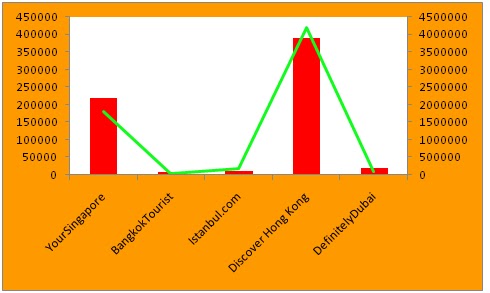
Fig 7: shows the total unique visits and page views for the five official sites, over the month of November 2011. The column chart shows unique visits, where as the line graph shows the page views. Source: double click ad planner. 

Fig 8: shows the average time spent by a visitor in minutes: seconds. Source: double click ad planner

Table 2: compares the home page of the five official websites across some of the basic parameters.

. Table 3: compares the home page of the five official websites across some of the advanced parameters

In terms of unique visitors and total page views, discover Hong Kong has an insurmountable lead over others. This is followed by Singapore; others are far behind. Discover Hong Kong is available in 14 different languages, a unique feature missing in other websites. The closest to this, is Definitely Dubai, which is available in 5 different languages. Other than the multilingual function most of the websites provide all the basic function listed in table 1.  It is the advanced parameters which seem to be the differentiating factor. Yours Singapore has all the five features, followed by Hong Kong with four. The other three have three each. All the five websites have designed very attractive website with lot of multimedia works-videos, photos, flash etc. One of the unique features, of the two successful website is availability of geographical customization- provision of custom made packages for different geographies. 


Travel websites

Travel websites play a very significant role in tourism marketing and destination branding. Not only do they provide booking facilities for a gamut of tourism activities but also share reviews for tourist destination in the form of – comments, articles, videos and photos. These travel websites are loved by tourism enthusiast and amateur tourists alike and some of them have huge fan following all across the globe. A larger presence in such websites will ensure stronger brand image for destinations. The given part of the report will compare the five destinations across three of the most popular tourism websites- Frommer, Trip Advisor and Virtual tourist

Frommer

Table 4: shows the no. of destination guides, communities and photos for the five destinations in Frommer.

Trip advisor

Table 5: shows the no. of reviews, forums and articles for the five destinations in Trip Advisor.

Virtual tourist

Table 6: shows the no. of tips and reviews, forums and articles for the five destinations in virtual tourist.

With the help of the three tables it could be concluded that none of the destination emerges as a true winner. There is a lot of variability across the three websites. While Frommer and Trip Advisor are dominated by Bangkok; Singapore has stronghold in Virtual Tourist. Even within the sites there are lots of variations. For instance, Istanbul has the 2nd least number of tips & reviews in virtual tourist where as highest number of videos. Another point to be considered is that if there is no winner, there is no loser as well. All the five destinations have substantial presence across the three websites in the form of- reviews, photos, videos, forums and communities.


Facebook

Digital media landscape is transforming, with social media playing a very pivotal role. One of the most popular social media site across the globe is Facebook or FB. FB which is available in more than 70 languages, has more than 800 million active users across the world. More than 50 percentage of active users log on to FB on any given day .On an average, every user is connected to 130 friends and 80 communities, events etc. (Facebook statistics, 2011) with the help of its phenomenal popularity and sheer volume across the globe, FB provides a very vibrant platform for marketers, to communicate and interact with their target customers. It also plays a very prominent role in building brand image for tourist destinations. The given part of the report will compare the brand strength of the five tourist destinations on FB. Since there are many FB pages related to the destinations and comparing all of them not possible; the given analysis will select the most popular page for all the destinations and do a comparison among them.     

The pages are:
Dubai: I Love Dubai 
Istanbul: Istanbul, tours/ sightseeing
Singapore: YourSingapore
Bangkok: Bangkok, public places
Hong Kong: Hong Kong, Attractions, things to do

Fig 9: shows number of likes and people talking about the given destinations on their FB pages. Source: FB pages

Marketing a destination on FB also requires a lot of activities and updates on the group page, besides just having a page. In order to comprehend the level of activities done on each page, a seven day period- 19th Dec to 25th Dec, has been selected. Under the given period, all the activities- updates, likes, comments and shares have been recorded, as depicted by the following table. 

   Table 7: shows the number of updates, comments, likes and shares during 19th to 25th Dec, for individual pages of tourist destinations. (Only updates related to tourism has been included)

On FB, Dubai seems to have an edge over other destinations. Its page “I love Dubai”   can be considered as one of the best well managed and organized FB page for tourist destination across the globe. Properly moderated, it comes up with regular updates of photos and videos, reflecting the grandiose and extravagance of Dubai. The beautiful photo graphs, attract a large number user likes comments and shares. Other cities which come close to Dubai could be Istanbul and Singapore (YourSingapore). Istanbul like Dubai, is well moderated but is also fraught with lot of irrelevant updates- political spoofs, funny pictures etc. Another flaw for page “Istanbul” could be predominant use of Turkish language, which deprives it of an international appeal. YourSingapore is another well managed page but needs more updates. For the other two, lot needs to be done. Large number of user generated updates, which includes greetings and adieus, contradict with the professional outlook expected out of such pages.


You tube

Another powerful social media tool is “You Tube”. Over 800 million of unique users visit You Tube every month. Over 100 million of users take social actions such as like, share and comment on You Tube every week. (Youtube.com press statistics, 2011) You tube does not only play a pivotal role in branding a tourist destination, but also contains negative perception by interacting directly with the tourists. (Sofia R, Brain H, 2010)
 
Fig 10: shows the total number of tourism related searches and total views for top 10 searches, for the five destinations. Column chart shows the no. of searches, whereas line chart with data labels show the total no. of views.  Source: You Tube        

Conclusion and Suggestions

It could be comprehended from various charts and tables that none of the five destinations emerges as a clear cut winner. However, someone close to the numero uno position could Hong Kong, followed by Singapore. Both the city states appear to be comparatively well equipped in building their brand on the web world. Based on the analysis, there are following suggestion, which could help these states further enhance their brand image -

·         Bangkok: with an intake of 10.2 million tourists, it is Asia’s most visited city. (enjoyyourholiday.com, 2011). The city also enjoys a high no of user generated reviews, communities, photos and other user generated contents in travel sites such as trip advisor, virtual tourist etc. However it has comparatively lesser web presence as estimated from the search engine section. In the social media segment it has strong base in You Tube, but needs to use Face Book more aptly. It can also work on its website by adding custom made packages.

·         Istanbul:  is the only city in the globe, stretched across two continents- Asia and Europe. In most of the sections, Istanbul has shown a moderate show, neither too good nor too bad. An area where it needs to put some extra efforts could be You Tube. Another could be official tourist page. The English version (the Turkish version is doing good with 2,00,000 visitors over November 2011) which definitely engaging as reflected from the average time spent, is still not attracting large volume of visitors like its counterpart, Singapore and Hong Kong. One possible measure could be annexing a Russian and German version as Turkey receives quite a good number of tourist arrivals from the two countries. 


·         Dubai: like Istanbul, Dubai has also showcased moderate performance across most of the sections. One area where it has been exceptional could be FB page “I love Dubai”. With arsenal of spellbinding photographs of Dubai, has been successful in its attempts of engaging and communicating with people. Besides working on platforms like virtual tourists, Dubai can rework on its official tourist site. Adding custom made packages and an Arabic version can help in more traffics.


·         Hong Kong and Singapore: are already strong on the web. A simple piece of advice for Hong Kong could be linking social pages with the official tourist website.


Limitations

The given report has some fundamental limitations such as:

·         Search engines: based on the keywords, the number of searches give only an approximate estimation of web content available. More ever the total number of searches keeps on varying with time to time.

·         Reviews: reviews themselves are not 100 % accurate estimation of the brand presence, since it is not just the numbers but quality of reviews that also matters. More over a negative review can be detrimental to the brand value.  

·         Google double ad click: the unique visitors, page views and average time spent, calculated by Google double ad click are just estimation rather than the exact data. However out of many website measurement tools available on the internet, it is considered as the most authentic by many web media evangelist.     


Reference
1>    Nguyen N, 2007,tourism trends and the effect of online booking for Vietnam travel market, available < http://www.findvietnamresorts.com/company/advertise/research.pdf>
2>    Quan Z, Rich D, 2005, Usability issue in city tourism websites: content analysis, p-3, available at http://www.arlt-lectures.com/cross-cult-city-tour.pdf
3>    Facebook statistics center, 2011, available at http://www.facebook.com/press/info.php?statistics
4>    Youtube.com, 2011,press statistics, available at < http://www.youtube.com/t/press_statistics>
5>    Sofia r, Brain H, 2010, the use of you tube as tourism marketing tool, available at < http://eresearch.qmu.ac.uk/2315/1/2315.PDF>
6>    Enjoyyourholiday.com, 2011, top 10 visited cities in the world, available at < http://www.enjoyourholiday.com/2011/04/18/top-10-most-visited-cities-in-the-world/>  
 

Fig 1: online brand display image. Source: reactorr.com

Saturday, July 16, 2011

Turkey and UAE as Trade Partners: Generalist Overview


                            Fig 1: national flag of Turkey (Source: senojflags.com)                                               

Turkey and UAE are undergoing a very interesting phase in their bilateral relationship, with trade between them undergoing a rapid escalation in the last few years. Though still in its crawling phase, the bilateral trade between the two nations has witnessed a significant growth. According to a study conducted by researcher Ahmed Al-Ananbeh of MoFT’s Department of Analysis and Trade Information, bilateral trade between the nations has increased from US $ 2.074 billion in 2006 to US $ 7.99 billion in 2008. Both Turkey and UAE offer a great case study to explore- one an oil rich Gulf state, with a small population, considered richest among the world in terms of per capita income; other an emerging economy of great geo political significance, placed between the crossroads of Europe and Asia, with a predominantly western orientation. UAE is presently the 3rd largest export destination for Turkey, with Turkey’s export to UAE increasing from US $ 2.892 billion in 2006 to US $ 7.473 billion in 2008. There had also been a gradual increase in UAE’s non oil export and re export to Turkey. In 2010 Turkey accounted for 1.4% of UAE’s non oil trade with the world. Other than trade both the nations are also exploring business opportunities with each other. Presently UAE’s investments in Turkey are worth US $ 5.01 billion and turkey’s investments in UAE are worth US $ 6.51 billion. (moft.gov.ae, 2011)

In the light of growing relationship between the two nations, “Management Guru” blog will write a set of articles, exploring the various facets of the relationship. The very 1st blog in the series will just give a generalist overview- country profiles, nature of trade, attractiveness of both the destinations etc. This will be followed by further articles attempting a detailed analysis of the trade consisting of individual items, future prospects, areas of improvements, alternative scenarios etc.      

Turkey and UAE: country profiles

The following part will compare the two nations across various social and economical parameters along with the graphical representation of data pertaining to the trade figures of both the nations. 


Table 1: - compares Turkey and UAE across various social and economic parameters

                                  Source of data: CIA fact books, Euro Monitor etc.                        

Fig 2: Value of Import for UAE in US $ billion, over the period of years.   Source: National Bureau for Statistics, United Arab Emirates


Fig 3: Value of non oil Export and Re Export for UAE in US $ billion, over the period of years.   Source: National Bureau for Statistics, United Arab Emirates

UAE Turkey: Trade Statistics

Table 2: Data pertaining to total weight of Export of Turkey to UAE and vice versa
                                Source of data: National Bureau of Statistics, UAE  
Table 3 : Data pertaining to total value of Export of Turkey to UAE and vice versa 

                                Source: National Statistics Bureau, UAE

Nature of Trade between Turkey and UAE

Major exports from Turkey to UAE include aluminum, precious stones, food stuffs and beverages, plastics followed by animal products, chemicals, vegetable products etc. The following pie chart shows the percentage wise break up of major export items from Turkey to UAE in 2010.

                      Fig 4: percentage wise break up of Turkish export to UAE in 2010


In the given figure
(a stands for base metals and their articles; b stands for pearls stones and other precious metals; d stands for others; c stands for articles of woods; e stands for food stuffs; g stands for textile and textile articles; c stands vegetable products; f stands for plastic, rubber articles; h stands for chemicals and allied products)

Total value of non oil exports from UAE to Turkey  is US $ 160 million. in 2010. The major export items are – Pearls and precious stones followed by plastics, rubber etc. The following pie chart gives a percentage wise break up the UAE’s export to Turkey


                      Fig 4: percentage wise break up of UAE's export to Turkey in 2010

(In the given figure A stands for pearls and precious stones; B stands for articles of stones, Mica etc; C stands for plastics, rubbers etc; D stands for products of chemicals, E stands for food stuffs and beverages; F stands for others.)


Future Prospect


Presently the trade between Turkey and UAE is in its crawling phase, with GCC and UAE comprising a comparatively smaller share in Turkey’s overall trade in the MENA region. But it has huge latent potential with both the nations taking strong measures to boost their relationship further. In Q1 2011, the total trade volume between them stood over US $ 1.3 billion, 50 % increase compared to the same period last year. (Khaleej Times, 2011). 


The following part of the blog will evaluate the future prospect of trade between Turkey and UAE.


Turkey’s attractiveness


Turkey is an attractive, trade partner and investment destination for UAE. Turkish attractiveness is due to a wide range of Economical, Socio-Cultural, Legal and Geographical factors, stated below (Middleeastelectricity.com , 2011) -     
·         With a GDP growth rate of 8.2% in 2010, it is presently among the fastest growing European nations.
·         Strategically well placed between the cross roads of Central Asia and Europe, it is well connected with 1.5 billion lucrative consumers in the region.
·         60 % of its population is aged less than 30, providing a huge and sustainable consumer base.
·         Turkish annual trade standing at US $ 320 billion in 2010, constituted 1 % of the world trade.
·         Turkey has strong presence in the MENA region making it easier for UAE to build further relationship.
·         Since both UAE and Turkey are Islamic societies and UAE had also been once part of the bigger Ottoman empire- both the nations share rich and glorious Islamic heritage and there should be comparatively less cultural differences between them.
·          UAE nationals do not require VISA before their arrival to Turkey; they can apply for a VISA once they arrive.
·         Turkey is geo graphically close to UAE. Istanbul port is at a distance of 6700 KM from Dubai (Jebel Ali port ) where as the aerial distance is just 2995 KM. (The higher port distance is on account of ships travelling via Suez Canal to reach each other)

UAE’s Attractiveness


Like Turkey, UAE also offers attractive business opportunities, for an emerging economy like Turkey. Other than the common cultural and geographical factors that it shares with Turkey, UAE’s strength lies in the following-
·         UAE is among the richest nations in the world. With a GDP per capita of US $ 40,000 in 2008, it was ranked as the 19th richest nation in the world. (World’s richest countries.com, 2009). With an annual disposable income of US $ 120 billion (2010) it offers a lucrative and elite consumer base. (Euromonitor International, 2011)
·         UAE had been one of the fastest growing economies of the world in the last decade. Due to global economic slump, followed by real estate crisis, GDP was hit hard in the last couple of years. But with oil prices’ increasing again, the economy is back on track. 
·         Dubai, 2nd largest Emirate of UAE enjoys the status of a regional distribution center and is the 3rd largest re export center after Hong Kong and Singapore. Dubai has strong ambitions of transforming into a global trade hub. Jebel Ali port with an annual capacity of 11.6 million TEUs, is undergoing expansion and is expected to handle 55 million TEUs by 2030. 
·         UAE is strategically placed between the cross road of East and West and North and South.
·         With the help of flagship carriers like Emirates Airlines and Etihad Airways, UAE is well connected to whole world.
·         With ambitious plans- Abu Dhabi 2030 and Dubai 2015- UAE is aggressively trying to transform and diversify its economy, thereby providing ample business opportunities for its trade partners.

Though both the nations seem as attractive trade partners,  the future for them is also fraught of hindrances  Lot of Turkish people are interested in visiting Turkey for trade; for which they need to apply for visa before their arrival. (The same does not hold true for UAE nationals visiting Turkey). Downside of UAE is that though it is one of the richest nations in the world, its small population of 4.7 million does not represent a very big consumer base. Turkey has bigger market bases- Russia, EU nations, Poland- in its nearby vicinity. There are other areas of concern that has to be taken care of in order to bolster the burgeoning trade between the two nations.        


References 

1>     1>Moft.gov.ae, 2011, moft releases study on UAE Turkey trade exchange, available at http://www.moft.gov.ae/en/det.aspx?detid=262&resourceid=30
2>   2> Khaleej Times, Turkey targets 20 % rise in food trade with UAE, available at http://www.khaleejtimes.com/DisplayArticle.asp?xfile=data/business/2011/July/business_July203.xml&section=business&col=
3>   3> Middleeastelectricity.com, 2011, Turkey-UAE investment reach $ 10 billion in 2010, available at http://www.middleeastelectricity.com/Global/Middle_East_Electricity/pdf/TurkeyUAEinvestmentshit10bin20104Mar11GN.pdf
4>    4> World’s richest countries.com, 2009, home page, available at http://www.worldsrichestcountries.com/

Saturday, April 23, 2011

Egypt VS Turkey: as tourist destinations


In the following blog the author will attempt  doing a comparative analysis of the two biggest tourist destinations from the Mediterranean region, Egypt and Turkey, with the help of qualitative as well as quantitative frameworks. Both Egypt and Turkey are world famous tourist destinations sharing lot of similarities across religious, cultural social and economical parameters.


Profiles as tourist destination


Egypt: Egypt, also known as the cradle of civilization has a very strong and vibrant tourism industry, employing 12% of the work force and receiving around 125 Million tourists every year (Dinar Standard, 2011). It has a wide range of tourist avenues such as Pyramids, Sphinx and other magnificent monuments; exotic desserts, wild life parks and sea beaches; shopping complexes and other life style centers and state of the art golf courses; providing a wide range of activities such as sight seeing, dessert safaris, golf tourism, cultural tourism, sea activities, cruising, adventure sports etc. (Egypt. travel, 2011)


Turkey: Turkey also has a  very rich history and cultural heritage and is  melting pot of various civilizations such as European, Arabic and Central Asian. Like Egypt it also has a wide range of tourist avenues such as; beautiful cities like Istanbul, Antalya, Ankara etc; rugged landscapes, serene and calm sea beaches and coastlines, full of exotic floras and faunas; plethora of heritage sites, museums, monuments and archeological sites etc. The range of activities at Turkey includes site seeing, adventure sports, winter sports, golf, rafting, eco tourism, yachting, night life, cultural tourism, shopping, Turkish bath, cuisines, conventions, wild life adventures etc. (tourismturkey. org, 2011)


Following table  shows the demographic and economic Indicators for 2010 (Euromonitor, 2011):


The following figure compares the GDP growth rate of both, Egypt and Turkey, #


Social Indicators of Egypt and Turkey (Source: UNICEF)


comparison of Egypt and Turkey on some selected social parameters


Tourism industry in Egypt and Turkey


Egypt


Since ancient time Egypt has been a very popular tourist destination, attracting large number of tourists from Europe, Middle East and Africa. In 19th century after Napoleon's invasion,  people once again got interested in Egypt. The new era of tourism in Egypt began in 1989-90, when many of the leading hotels were privatized, airline sector was liberalized and the Egyptian govt. came up with some strong marketing campaigns. Since then the industry has been moving with an accelerating pace, occasionally hit hard by terrorism and political unrest. Last year out of the 125 Million tourists it had received, Russia with 14 % had the highest share, followed by United Kingdom, Germany and Italy. Though presently due to the political unrest the tourism industry had been affected, but in the long run it is expected to grow further, owing to expected political stability and transparency as well as more inflow of tourists from emerging economies like China and India.


The following histogram shows the growth of tourism industry since 1989-90, for Egypt

The following figure shows growth of annual revenue from tourism, over the period of   years,
 

The following pie chart shows the percentage of 10 major countries, exporting tourist to Egypt, in the year 2007 (values given in 000s)
 
Source of data: (Information development support center)
 
Egypt is primarily known for cultural tourism. Having large number of Pharaonic, Roman, Coptic and Islamic monuments and archaeological sites, it’s a paradise for culture tourists coming from various parts of the globe. Though position of cultural tourism is unparalleled, Egypt had also made huge investments in developing various other forms of tourism such as, spa tourism, sports tourism, dessert safaris, beaches tourism, adventure tourism, eco tourism, convention tourism (business tourism) etc. In the recent years, government of Egypt along with the support of International Monetary Fund and other international organizations had made huge investments developing the tourism sector, a sector that constitutes 40 percent of Egypt’s non commodity export and employees more than 2 Million people directly or indirectly.;


Turkey

Thanks to its, rich History, wide range of exotic landscapes, beautiful beaches and strategic position, tourism industry in Turkey had made noticeable growth in past few years, better than many of its European counterparts. Turkey’s tourism sector took a leap during the early 80s. In 1980, Turkey had mere 60, 000 beds and the tourism industry constituted just 0.8% of the GDP. (Mahmut Zortuk, 2009). Presently in 2009 with revenue of around US $ 21 Billion, constitutes 3.4% of the GDP and 20.8% of the export. According World Tourism Organization, Turkey is ranked 7th among the best tourists destinations in the world and holds 9th position in terms of annual revenue from tourism. (Sunday’s Zaman, 2011) Istanbul; the capital of two of the greatest civilizations in the world, Byzantine and Ottoman civilizations; along with Antalya are the two important points focal point of Turkish tourism, comprising of 60% of the tourist intake . The city was the 3rd most visited city in Europe as on 2008, and was the cultural capital of Europe in 2010. (Invest in Turkey, 2009)

The following columns shows the growth in inbound tourism over the period of time


Source of the data: Middle East and North Africa report, Istanbul Bulletin, Sunday Zaman, Country studies, Central daylight time

The following figure shows growth of annual revenue from tourism, over the period of   time,


Source of data: Middle East and North Africa report, Istanbul Bulletin, Sunday Zaman, Country studies, Central daylight time

Over the coming years, tourism industry in Turkey is expected to grow further, with around 3.3 Million tourists in 2012. Around 40% of tourists come from, Russia, United Kingdom, Germany and Iran. Major tourist attraction in turkey includes, archaeological sites, monuments, museums, beautiful coastline with 314 beaches, rugged landscapes etc and major forms of tourism includes cultural tourism, winter tourism, beach tourism etc. Other alternative forms of tourism had been developed such as medical tourism, religious tourism and sports tourism. Turkey having 14 golf courses, 20 skies and 40 marinas as of 2008, had also been an emerging sports tourism destination. Similarly it is evolving as a medical tourism destination, with a large number of medical tourists coming from Middle East region.


Comparing Egypt and Turkey on a “Nine Point” Analytical frame work @


The success of a tourist destination depends on a wide range of factors ranging from places to visit, connectivity to political stability and infrastructure etc. In the following part of the blog, both the destinations will be judged on a set of nine parameters, with every parameter having a specific weight age score, depending on the importance of the parameter. Based on the competencies shown under individual parameters, they will be rated from 1 to 5, with 1 being very low to 5 being very high. Finally the individual scores will be multiplied with the weight age score and their sum total over all the nine parameters will be the final score for the individual states.


Places to visit: the success of any tourist destinations relies heavily on the things it has to offer, whether it has places exciting enough to be adored by tourists, coming from various parts of the world. Under this section, both Egypt and Turkey has enough to offer; while Egypt had some most sought after archaeological sites and monuments, along with beautiful beaches, exotic desserts, spas, golf courses, convention centers Nile cruises etc; Turkey is also rich with archaeological sites, museums, monuments along with beaches, springs, flora and fauna, sports and medical utilities, convention centers, exciting night life etc. Hence both have been rated as 5.

Infrastructure: includes, hotels, resorts, roads, public transportation, telecommunication, ICT (information and communication technologies), convention centers etc and plays a very important role in the tourism industry by ensuring comfortable and hassle free stay for the tourists. Turkey has around one Million beds, 46 airports, and extensive road networks, Turkey is ranked 55 in the T&T business environment and infrastructure sub index, consisting of ,air transport, ground transport, tourism, ICT, infra structure, tourism infra structure. Turkey lags behind in infrastructure in contrast to, many of its developed counterparts in Western Europe, UAE, USA, Bahrain, Singapore etc. In the given sub index Egypt has a rank of 74. Based on their rankings, a score of 3 and 2 had been given to Turkey and Egypt respectively.

Safety: is another major concern for the tourists, it has a huge psychological impact in the minds of visiting tourist and a perceived feeling of lack of safety can often result in avoidance of a destinations. Both Egypt and Turkey have their own safety concerns, with the situations presently being more serious in Egypt due to the current political instability. There had been many attacks on tourists by fundamental forces in both Turkey as well as Egypt, resulting in high causalities, there by hitting the tourism business hard. Along with religious fundamentalism, Turkey also struggles hard with Kurdish uprising in the South, which had occasionally targeted tourists. Based on these serious safety concerns a low score of 2 had been decided for Egypt and Turkey, which had been further revised to 1 in case of Egypt, in view of the present revolt, which resulted in one Million tourists leaving the place.

Cost: Both Egypt and Turkey are comparatively cost effective in comparison to many of its counterparts in Europe. Egypt is one of the low cost tourist destinations where the cost of travelling is 20 % of the United Kingdom. Cairo its largest city has a rank of 224, in terms of cost of living among 276 places in the world. According to an estimation by budgetyourtrip.com; average daily travel in Egypt, which includes accommodation, food, water, local transportation etc could cost around US $ 33.5; souvenirs could cost around US $ 100 and daily travel and cruise trips can cost around US $ 30. In case of Turkey values for the same will be US $, 47, 8 and 55 respectively. Cost of daily travelling can cost US $, 200, 164, 77 and 51 in United Kingdom, USA, Mexico and Thailand respectively. Few tourist destinations cheaper than these two places could be Morocco, India etc. Hence for cost, on a scale of 5 a score of 5 had been given to Egypt where as 4 had been given to a bit costlier Turkey.

Strategic Location: Turkey is strategically placed between the cross roads of Europe, Middle East and Central Asia. Similarly Egypt, situated in North Africa is at a distance of mere four hours from Europe and is at the door steps of Middle East. For both of them, strategic location have played pivotal role in their tourism industry. In the given parameter a score of 5 had been awarded.

Marketing: Owing to the fact that tourism plays a very pivotal role in their individual economies, both Egypt and Turkey intend to take strong initiatives in marketing their destinations. Ministry of tourism and culture in Turkey has an ambitious plan of achieving 50 Million tourists and US $ 40 Billion as revenue by 2023, as a result of which it has opened offices all across the world, taking strong marketing initiatives. In spite of this, marketing expenditures are believed to be low in comparison to some of the heavily marketed destinations like Spain, UAE etc. The same holds true for Egypt, though it has its own tourism ministry with a fix budget allocated for marketing, a lot more can be done. In case of both Turkey as well as Egypt handful of nations like Russia, United Kingdom, Germany, Italy and some Arab countries constitute the majority of their tourists, indicating lack of diversity in their marketing campaigns. Hence a score of 3 had been given to both the countries.

Climate: Climate is another factor, deciding the success of a tourist destination, though few adventurous souls might like harsh weather conditions, for most of the leisure tourist it might be a turn off. Egypt has comparatively moderate temperature with warm days and cold nights; during summer temperature fluctuates between 43 degree C during day and 7 degree C in night, whereas during winter, varies between 30 degree C to 18 degree C. The warm weather in Egypt is considered to be very refreshing for tourists. In comparison to Egypt, Turkey has a varied climate with coastal areas having typical Mediterranean climate with hot summers and mild, wet winters and East of the country having snowy winters and warm summers, often used for winter tourism. Istanbul has a cooler version of Mediterranean climate where as Antalya; home to some of the best beaches and resorts has a much warm coastal temperature. On account of their favorable weather conditions a rating of 4 had been given to them.

Social factors: People from both Egypt and Turkey are known for their warm and loving attitude towards the tourists. In Egypt a large number of people speak and understand languages like English, French, and German etc. Similarly in Turkey English is taught as second language in most of the govt. sponsored schools, other than English lot of people do speak and understand German, Russian, Arabic etc. In terms of other social factors affecting tourism industry, directly or indirectly such as literacy rate, higher education, telephone penetration, internet penetration etc Turkey has a clear cut edge on Egypt, hence 4 had been awarded to Turkey and 3 for Egypt.

Legal factors: Factors such as the visa procedures and the legal system of a country are also important for the tourism industry of a nation. Both Turkey and Egypt have easy visa obtaining procedure and legal frame works very much in line with the Western world, hence there is not much of a trouble for the tourists. A score of 4 had been given to both of them.

The following table followed by graph shows the score of both the countries across the nine parameters:


            Egypt : sub total 157

           Turkey : sub total 167


Though both Egypt and Turkey had emerged as great tourist destinations in the past few decades, with both having their unique selling proposition; one an ancient land with some of the most magnificent monuments and archaeological sites while other, a moderate and prosperous Islamic society also blessed with a rich cultural and historical heritage and catching up fast with its other developed counterparts, both in terms of outlook as well as approach. If data speaks something, then the comparison between Egypt and Turkey goes in favor of the later. Not only does Turkey has a bigger tourism industry than Egypt and has better figures under various social and economic indicators but also has 10 point higher score under the nine point analytical framework. The difference in the scores can be explained with the help of underlying difference in the structure of Turkey and Egypt. Both the nations do have their own share similarities, since both, are Moderate Islamic societies having very rich heritage, are making headways in the tourism industry by investing in various new and alternate forms of tourism and are moderately cost destinations providing a value based proposition to the tourists but along with this similarity there are some gross dissimilarities also. While Egypt had just started liberalizing its market, investing in social infra structure and post revolution is attempting a transition into a liberal and transparent democratic system; Turkey on account of its inclinations towards the European world had made huge strides in investing in social and physical infra structure, is a moderate, transparent and secular democracy and has implemented economic reforms much before. Turkey itself has huge ambitions of achieving 50 Million tourists by 2023 and is yet to achieve its full potential as a tourist destination, yet it can be an inspiration for the newly evolving Egypt. Turkey, a prosperous and modern society with strong Islamic roots can be a ‘great model state’ for a new Egypt.


The Turkish model can not only be beneficial for the tourism industry in Egypt, but can also be an inspiration for various parts of its, economic, social and political future.

# for the year 2011 for Egypt, the estimated GDP growth of 5.5% has been revised to 3.5%, due to the current political turmoil.


@ This nine point frame work had been made with the help of a seminar session attended by the author at Sheffield Hallam University, Sheffield, United Kingdom. The seminar was attended by students from various countries across the globe such as, India, Germany, China, Pakistan, Oman, Libya, United Kingdom etc


Reference:

1> Dinar Standard, 2011, Egypt revolution: facts and updates, available at < http://dinarstandard.com/challenges/egypt-crisis-business-facts-updates/>

2> Egypt. travel, 2011, home page, available at < http://www.egypt.travel/?flashinstalled=2>

3> Tourismturkey.org, 2011, home page, available at http://www.tourismturkey.org/

4> Euromonitor, 2011, Reference books, available at http://www.euromonitor.com/turkey/country-factfile

5> Mahmut Zortuk, 2009, Economic impact of tourism on Turkey’s economy: evidence from cointegration tests, p- 231-232

6> Sunday’s Zaman, 2011, tourism industry making headway in Turkey

7> Invest in Turkey, sectors, tourism