Showing posts with label FINANCE. Show all posts

Saturday, June 4, 2011

Etisalat : Strategic Analysis

                                      Fig 1: Etisalat Logo ( source : PTCL worker.com)
                                                   
 The given blog is exclusively dedicated to the telecomm giant from Middle East, UAE based Etisalat. Etisalat is among, one of the non oil sector based success stories from the Gulf and the given blog will do a detailed analysis for it. This will consist of the basic introduction followed by the overall telecomm market in UAE. In the next part the growth and expansion of various businesses of Etisalat over the last decade will be studied,  followed by some of the major international subsidies of Etisalat. In the concluding part the future strategies of Etisalat will be analyzed. Once the blog will be done, another blog, dealing with the financials of Etisalat will be rolled out soon.

Introduction

Emirates Telecommunication Corporation, branded as Etisalat is one of the major telecommunication companies in the world, operating across Middle East, Asia and Africa. It provides mobile and fixed line data and voice services to individuals, enterprises, telecomm companies etc. It also provides a wide range of high tech and complimentary services to telecomm companies including SIM card manufacturing, payment solutions, staff training, peering, voice and data transit, sub marine and land cable services. (Etisalat.ae, 2011)


The company was founded in 1976 as a joint venture between International Aeradio limited, a British company and local partners. Later on in 1983, the govt. of UAE had a 60% stake in the company and rest was publicly traded. From 36,000 exchange lines in 1976, it was having around 7, 47,000 lines in 1998. Today Etisalat is considered as one of the biggest success sagas in Middle East and is one of the biggest contributors to the UAE government after the traditional oil sector. Currently operating in 18 nations world wide, it enjoys around 135 Million aggregate subscribers and annual revenue of US $ 8.7 billion. (Etisalat Annual report, 2010)

Table 1:  various companies of the overall Etisalat group


Fig 2: shows breakdown of revenue (as on Dec, 2010) (Source: Etisalat annual report 2010)


Fig 3: shows the breakdown of Etisalat group as on Dec, 2009 (source: Etisalat annual report 2009)

Telecommunication sector in UAE:-


The growth of telecommunication sector at UAE had been synonymous with the growth of Etisalat, its major telecommunication company. The telecom sector in UAE had been highly regulated with Etisalat having monopoly in the market for most of the time. In spite of having monopoly like many of its other Emirati counterparts, Etisalat had always been upfront in coming up with newer technologies and value based innovation in the market. By 2005 mobile penetration was more than 100 % where as internet and broad band penetration was more than 60 %. The market dynamics changed in 2006 with the emergence of Du, another telecomm company in the market. (2dayDubai.com, 2009) Du is owned- 40 % by Dubai government, 20% by Mubadala, 20% by TECOM (Dubai technology and commerce free zone) and rest 20 % is owned through publicly listed shares in Dubai financial market. Presently due to saturation as well as competition the top line of the Etisalat, the major telecomm company seems to be affected in UAE, but it is growing rapidly through international expansion and acquisitions of other players. Moreover the overall ICT sector of UAE (consisting of IT along with telecom) is poised for a strong growth in the coming time. Both the major Emirates of UAE- Dubai as well as Abu Dhabi have ambitious growth plans in the form of Dubai 2015 and Abu Dhabi 2030 respectively and they realize the fact that strong ICT sector is a precondition for achieving these ambitious plans. The ICT sector is expected to get strong boost due to multibillion dollar infrastructure development plans, economic diversification and an exuberant SME segment, in the nearby future.


Growth of Etisalat over the last ten years


From a humble beginning in 1976, Etisalat has grown into a giant organization. According to financial times it holds 140th position among the top 500 companies, in terms of market capitalization. By the mid of 2000 Etisalat had evolved  from a local player that provided basic wire line and data services to an international player providing a wide range of sophisticated services. The given section will discuss the growth track of Etisalat


Fig 8: showing the revenue and net profit of Etisalat, over the last eight years, Source: (Annual Reports 2002, 2005 and 2010)


                      Fig 5: Annual Etisalat mobile subscriber in UAE, over the last ten years (Source: Annual Report 2002, 2004 and 2010)


Key Insights from fig 4:-


• The CAGR (compound annual growth rate) for mobile subscribers , for the  period of last 10 years  is 18.5%

• The CAGR for 2000-05 is 26.1%, whereas for 2005-10 is 11.4%.

• There has not been any substantial growth in the last three years.


Fig 6: Annual Etisalat fixed line subscriber in UAE, over the last ten years (Source : Annual Report 2002, 2005, 2010)
Key Insights from fig 5:


• The CAGR for number of fixed line subscribers over the  period of last 10 years is very modest at 1.97 %.

• The CAGR for the period 2000-05 is 4 % whereas for 2005-10, there had not been any substantial growth

• The overall fixed line market for Etisalat UAE had reduced in the last two years.


              Fig 7: shows the total number of internet subscribers in UAE over the last 10 years, Source( Annual Report 2002, 2005 and 2010)

Key Insights:Etihad Etisalat:


• The CAGR of internet subscribers for Etisalat UAE, over the period of last 10 years is 20.2 %

• The CAGR for 2000-05 is 20.3%, whereas for 2005-10 is 20 %.

• After showing substantial year on year growth for the 1st nine years, the market has taken a dip in the last year.

Fig 8: shows the national as well as international calls in billion minutes, over the last ten years, Source ( Annual Report 2002, 2005, 2010)  

Key Insights:


• The CAGR for, national calls is 10.5 %, international calls is 11.9 %, over the last 10 years.

• The CAGR during 2000-05, for national calls is 18.2% and for international calls is 25.31 %. The CAGR during 2005-10, for national calls is 3.3 % and for international calls is 0 %.

• Both national as well as international calls have taken dip in the last two years.

General Insights:

After studying all the above graphs two important trends are emerging:-

• Etisalat has shown strong growth in all the sections during 2000-05, compared to 2005-10.

• In every section, the market is reducing down for Etisalat in UAE in the last couple of years, owing to saturation (In 2008 penetration in the mobile market had already reached 190 %, hence providing less scope for further expansion), competition by DU and global economic slowdown.

Global Expansion:


Etisalat operates across 18 nations in the Middle East, Africa and Asia. It is one of the fastest emerging global telecomm brands, primarily identifying underserved markets and targeting them with high quality, value based innovative services. The international expansion strategy for Etisalat consists of both, having fully owned subsidies as well as having majority and minority stake in various existing local telecom companies. In its tryst with inorganic growth and expansion, Etisalat had so far got commendable success. It is known for entering aggressivley into new markets and expanding the subscriber base very quickly. The following part will  discuss some of the Geographical success stories of Etisalat.


Etisalat Misr


Etisalat entered into Egypt (also called Misr in Arabic) in 2006, as 3rd mobile service provider in the country. Within 50 days of its launch it captured a base of one million subscribers, which had increased to around 10 million by today. Etisalat’s 2G network covers around 98 % of population while 3G network covers around 73 % of the population. (Etisalat.ae, 2011)
Atlantique Telecom, Moov

Atlantique Telecom (AT) operates in seven countries across West Africa. Etisalat initially had a 50 % stake in AT, which  increased over a period of time and eventually by February 2010, it has  full ownership of AT. Though all the seven nations are different in their socio economic cum political outlook but Moov, the common brand name for AT across the region, enjoys a very strong brand value. The region which is underserved with a low penetration presents a very strong potential for future growth. AT has a coverage of 54 % in the region.

Etisalat Nigeria

Nigeria, the most populous African state with 22 % mobile penetration is high up on Etisalat’s agenda of international expansion. Etisalat entered into the Nigerian market in October 2008 and known for its aggressive early movements, captured one million subscribers by June. By September 2011 it was having a subscriber base of 5 million. Etisalat is known in Nigeria for its top quality service and within year of its launch had been credited with the best service provider by the national telecom regulatory authority, Nigerian Communication Commission (NCC). Currently Etisalat is active across all the 36 states in Nigeria and has coverage of 73 %.

                  Fig 9: Growth of subscriber base of Etisalat Nigeria, source: (www.itp.net)


Etihad Etisalat (also branded as Mobily) is the second mobile service provider in the kingdom of Saudi Arabia after Saudi Telecom. It entered into Saudi Arabia in May 2005, after winning the bid for second GSM license. Mobily was one of the fastest growing GSM service providers in Middle East and North Africa and captured 3.8 Million subscribers, just within a year of its launch. Presently it has more than 17 million subscribers. Etisalat’s GSM service covers almost 97 % of the populated areas where as the 3.75 G service covers 80 % of the populated areas in Saudi Arabia. Etisalat has a 27 % share in Mobily where as 45 % are with six local partners, rest are publicly traded. (Etisalat.ae, 2011)


Pakistan Telecommunication Public Limited (PTCL)

Founded in 1947, Pakistan Telecommunication Public limited or PTCL is the largest telecomm service provider in Pakistan. In 2006, the Pakistan govt. sold 26% stake to Etisalat. 62 % is retained by the govt. whereas the rest 12 % is publicly traded.


Future Strategy


Etisalat is truly a global brand, with operations spread across 18 nations all over the globe. The future of Etisalat depends how well it expands in to various new geographies and technologies along with the kind of value based innovation it brings into the existing portfolios of geographies and product. Though a considerable part of revenue will come from the UAE, but due to intensifying competition and saturation of the market, maintaining a healthy top line from UAE will not be very easy. Following factors can play important role in deciding the future strategy for Etisalat: -


• New Markets: - newer markets like India and Sri Lanka will play a crucial role in influencing future strategy of Etisalat. Many of the existing markets like Pakistan, Sudan Tanzania and Waste Africa are still underserved and have huge future growth potential. Take for instance Sudan where fixed line penetration is just 1-2 %, and hence offers a great growth potential for telecom majors like Etisalat. Similarly India a nation with a population 115 Million and a penetration of 43 % provides strong growth opportunities. Though competition is quite intense in India with 12 players fighting for their share of pie, the sheer size of Indian market can deliver profitability to many of the competent players at the same time. Similarly in Africa, where many  nations are expected to achieve strong economic growth , the mobile, internet and fixed line penetrations are expected to shoot up, thereby providing a strong growth potential. Along with the existing markets, Etisalat needs , continue searching for newer underserved markets, and devise strategies for them.

Table 2 : calculates the future market potential for Etisalat


Future Growth of UAE: - UAE has strong future growth plans in the form of Dubai 2015 and Abu Dhabi 2029. UAE no more wants to be solely dependent on petroleum for its revenue and aims at diversify into various alternate industries such as ICT, High tech, defense, tourism, trade, media, SME segment etc. Currently these sectors are seeking huge capital investment and the expected future growth will influence Etisalat’s business in a positive way.


Innovative products for local markets:- Like any other globalized company, Etisalat needs to understand the dynamics of the local market and  come up with innovative solutions, customized for the local markets. One very good example can be the partnership between Etisalat Afghanistan and PTCL, which offered attractive rates between the two countries, resulting in quadrupling of traffic since the launch in 2010.  Etisalat needs to roll out such  innovative customized packages to lure more customers.


Content generation and monetization of mobile content: is an area, which can have future growth potential for Etisalat. (Comm.com, 2011)


Newer technologies: - The top management at Etisalat believes “Cloud Computing” as a deeply transformational trend worldwide, and  is planning to launch a wide range of service in this field in the near time. Another area that provides a great future potential is M2M (Machine to Machine) technologies. Etisalat is attempting to develop industry specific solutions in the given field. M2M technology holds a great future potential. According to research done by Research Infonetics in 2009 there were 87 million mobile embedded M2M connections, which are forecast to rise to 428 million by 2014, a compound annual growth rate (CAGR) of 38 %. (Comm.com, 2011)


# Un Served present market size= population * Coverage * (100 – Penetration) * Etisalat’s stake

Reference  

1> Etisalat.ae, 2011, company website, about us: corporate profile,


2> Etisalat annual report, 2010, p-3,


3> 2dayDubai.com, 2009, United Arab Emirates ICT sector and Dubai’s knowledge economy, available at < http://www.2daydubai.com/pages/dubai-ict-sector.php>


4> Etisalat.ae, 2011, Etisalat Misr, Etisalat.ae, 2011, Etisalat Etihad ‘ Mobily’ Saudi Arabia,


5> Comm.com, 2011, Seizing the moment, available at< C:\Documents and Settings\Administrator\Desktop\etisalat vs Du\Seizing the moment Comm_ Decisive coverage of telecommunications strategy.mht >


6> Comm.com, 2011, Seizing the moment, available at < C:\Documents and Settings\Administrator\Desktop\etisalat vs Du\Seizing the moment Comm_ Decisive coverage of telecommunications strategy.mht >
.

Wednesday, March 30, 2011

Potential economic benefits from uprising in Egypt


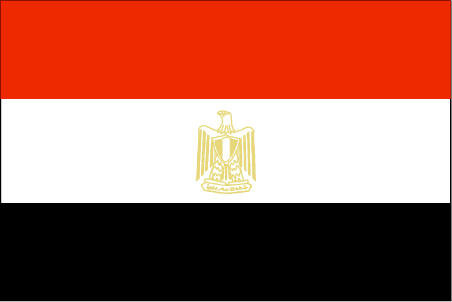
                             fig 1 : Egyptian Flag ( source: 1uptravel.com)

In the last blog, the author discussed about the short term loss on account of the Arabic Uprising. Though there have been losses of high magnitude, destabilizing individual economies for the time being, the uprising can bring a new change in the entire region, not only in socio -political sphere, but also in the economic one. The region, known for autocratic governments, corrupt bureaucratic machinery and lack of liberalization always struggled hard in achieving its full potential. The given uprising followed by regime change in many of the individual nations can help building a new Middle East, marked by transparency, efficiency and inclusive growth. The following blog will do a brief analysis of  the future prospects for Egypt, one of the largest Arab state and focal point of this uprising.  

Egypt

Egypt had been the focal point of the latest Arab uprising. The protest, breaking out in January end, finally ended up with extirpating the Mubarak regime. Though facing the heat of high inflation and huge loss in tourism sector, one of its prime sectors, Egypt holds a strong future ahead, provided the much needed transition into a stable and transparent democracy happens as soon as possible. 

Recent Situation #

Egypt is a US $ 188 Billion economy (nominal) with a population of 84 Million and a per capita income of US $ 2,450. In recent years, it had shown a decent growth in the range of 5-7% (fig 2), coupled with reform majors taken by the Mubarak regime; nevertheless 30% of population is living below the poverty line (Stuart Kauffman, 2011) with around 11.9% of the active population unemployed. In terms of various human development indicators, it had so far shown sub standard performance with a literacy rate of 66%, internet penetration of 21 % and had been ranked 101 out of 169 nations in the Human Development Index indicator (HDI). With a rank of 96 out of 179 nations in the “Economic Freedom Index”, it is considered as a less free economy. Tourism plays an important role in the economy, generating around US $ 10.8 Billion as revenue in 2009 and employing 12% of the work force. Another major source of revenue is oil and petroleum exports, (fig 3 gives a brief analysis of export items of Egypt in the year 2007) though Egypt is not considered among the major global petroleum exporters, yet valued at US $ 8 Billion, oil and petroleum exports constitutes around half of Egyptian exports. Other areas of foreign currencies are remittances from Egyptians living abroad and Suez Canal. (Dinarstandard, 2011)


fig 2: GDP Growth Rate of Egypt (source: Gafi.net)

                                        fig 3: Major export items of Egypt in 2007

Though Egypt had shown strong growth in the recent times (as shown by the figure as well), its economy has some major flaws, which are as follows (Isobel Coleman, 2011):        

 Egypt had grown with the rate of 4% during the 90s. In 2004 the Mubarak regime implemented major reforms, including institutional changes and reduction of tariff and taxes, there by making a growth of 6-8% in recent years, even during the global economic slowdown Egypt maintained a decent growth of 5%, but in spite of such growth there is a huge amount of economic inequality in Egypt. Much had trickled down to the poor populace.
  •        Recently the food inflation had been very high in Egypt. Egypt is one of the major wheat importers and spends around US $ 15 billion in food subsidies for the people living below the poverty line. 

  •           Egypt had made phenomenal progress in its education sector, with near 100% enrollment of girls and boys in primary schools. Even the enrollment for tertiary education has increased from 14% to 28%. In spite of such commendable success, there has not been a very concrete link between the education system and growth of the nation. The education system had been unable in equipping its populace to be employed by the private sector. Hence the rate of unemployment is around 30% among the university graduates.  

  •             Though Egypt seems comparatively liberal on paper, most of the businesses are still run with the help of personal contacts in the govt. authorities, there by undermining the innovative and entrepreneurial  abilities  of the educated youth.    

Current economic turmoil


Egypt had been hit hard by the uprising. It had been calculated by a French bank that at the height of revolution Egypt was loosing US $ 300 Million a day (Heather Murdock, 2011). Uprising, which happened during peak tourist season, ended up one Million tourists leaving Egypt, there by hitting hard a very important source of foreign currency. As an after effect of political turmoil; banks are conscious of lending and there had been a significant decline in credit growth; in the light of more govt. spending, the fiscal deficit of the govt. is expected to touch double digit; food supply had been affected in many areas, resulting in high price of food items; the Egyptian stock market was closed for five weeks, resulting in huge losses whose exact value is not known; many of the international corporations like Coca Cola, Volkswagen, General Motors, Marico etc have discontinued their operation for the time being. The annual growth rate, expected to be 6% in the beginning of the year had been revised to 4%. (Dawn.com, 2011)    

The way ahead: a new begining

Egypt had definitely been affected by the uprising in the short term; the stock market plunged by 9 % on 23rd March, 1st day of opening of stock market after two months. As described earlier the growth forecast had been revised by one third of the earlier projections. It is expected that it will take another one/ one and half years for the Egyptian economy to fully stabilize. In the midst of the present crisis there are some signs of recovery: many of the multinationals like Shell, Nestle, Asian paints etc have resumed their work, industrialists have vowed not laying of workers and to get back to the original condition soon, tourism business is expected to restore soon. But what is really exciting is the great change expected from the impending socio political restructuring and constitutional reforms, coupled with economical reforms and institutional changes. If every thing falls in place, this short term economic turmoil will evaporate sooner or later giving way to a democratic, transparent and development oriented Egypt where the benefits of growth, developments and liberty will be equally shared among various sections of the society. The following points can play an important role in defining future, desired by the Egyptians in large: 

·        Providing stability: Mubarak regime was providing the needed stability at the surface, but beneath, there was a tremor, resulting from the collective rage of the people, towards the corrupt and authoritarian Mubarak regime. This would have been making investors wary of investments, fearing that a wide spread protest might spread anytime, making the current system collapse (and the same happened). If after the uprising Egypt successfully transforms itself into a stable, transparent and liberal democracy, there will be a boost in the investor’s confidence in the market, leading to an increase in investments over the period of time.

·        Further education sector reforms: Egypt have made considerable investments in the education sector, there by achieving high enrollments in schools. But as discussed earlier, the system based on rote memorization, does not help individuals, getting job with the private sector. Egypt needs to further reform and streamline its education system, helping individuals in getting jobs with the private sector and benefiting from more globalization and privatization. (Knw@asb, 2011)

·        Making Egypt more competitive: Egypt along with other countries in the MENA region had not been benefited much from globalization owing to its poor competitiveness. So far since 1990s the region had just been able to maintain its share of per capita export where as many other emerging economies have doubled it. In order to alleviate poverty and provide job for its vast pool of youth, Egypt needs to become more competitive by reforming education sector, further integrating its economy with the world economy, streamlining further deregulation and investing in infrastructure. (Knw@asb, 2011

·        Cutting subsidies: Egypt provides petroleum products at deep discounts there by benefiting its rich class, since petroleum is primarily consumed by the richer sections of the societies. Rather than this, the given money can be diverted to labor incentive economic policies, there by enabling Egypt in employing its vast mass of youth and also boosting exports.

·        Silicon Valley of Middle East: The offshore outsourcing industry at Egypt is valued at US $ 1.1 Billion with global players like Microsoft, Google and Hewlett Packard ,having its operation units in Egypt. On the A T Kearny index of 2009, it ranked 6th as a global outsourcing destination, ahead  of countries like Jordan, Israel and Morocco. Egypt on account of its; vast pool of multilingual people speaking a wide range of languages such as English, Arabic, German, French, Spanish etc; proximity to major European business centers; overlapping time zones and working days on Saturday and Sunday (Egypt has non working days on Thursday, Friday) has the potential to transform itself into silicon valley of Middle East.   (Thomas White Global Investing, 2010)

·        Integration with Israel: during the past few years there had been some warmth in the Israel-Egypt relationship with Egypt supplying natural gas to Israel. The new govt. at Egypt must try carrying this relationship forward. Both, Egypt, on account of its large pool of hardworking people and natural resources as well as Israel, on account of its technological know how and Western orientation has ample space for economical integration. This will not only bolster peace in the region but will also make huge economic sense for both the strong forces from the Middle East. 

·        Using Turkey as the role model: After the revolution, Egypt basically can have  two role models for guiding itself through the future, Iran and Turkey and it must reject the former while select the later. Turkey, a very moderate, liberal and prosperous Islamic society with Western orientation can provide guidance  to Egypt in deciding  its future course of action. The Turkish model will ensure prosperity and liberty for Egypt along with commitment to its rich religious and cultural heritage. (Knw@Asb, 2011)      


# : most of the data are with respect to the year 2009

Reference:

1>  Stuart K, 2011, A new economic future on the horizon, npr.org, available at < http://www.npr.org/blogs/13.7/2011/03/07/134127499/egypt-and-israel-a-new-economic-future-on-the-horizon. >

2>  Dinar Standard, 2011, Egypt revolution: business facts and updates, available at < http://dinarstandard.com/challenges/egypt-crisis-business-facts-updates/ >

3> Heather M, 2011, Egyptian economy: facing the unknown, voiceofamerica.com

4> Dawn.com, 2011, worries about fallout of unrest on Egyptian economy, available at < http://www.dawn.com/2011/03/10/worries-about-fallout-of-unrest-on-egypts-economy.html>

5> Isobel C, 2011, Egypt’s uphill economic challenges, www.cfr.org, available at  

6> Knowledge@ Australian school of business, 2011, Uprising in Egypt: Rebirth of an ancient land, available at < http://knowledge.asb.unsw.edu.au/article.cfm?articleid=1332>

7> Knowledge@ Australian school of business, 2011, Uprising in Egypt: Rebirth of an ancient land, available at < http://knowledge.asb.unsw.edu.au/article.cfm?articleid=1332>

8> Thomas White Global Investing, 2010, Egypt: the new outsourcing hub, available at < http://www.thomaswhite.com/explore-the-world/postcard/2010/egypt-outsourcing.aspx

9> Knowledge@ Australian school of business, 2011, Uprising in Egypt: Rebirth of an ancient land, available at < http://knowledge.asb.unsw.edu.au/article.cfm?articleid=1332

Friday, January 21, 2011

Analysis of Middle Eastern and North African Economy ( in the last 2 years)

                             fig 1 Dubai written on wall( source: insidethemiddleeast.blog.cnn.com)                                          

Middle Eastern and North African economy (MENA) has gone through a lots of ups and down in the past couple of years. In 2009 due to global economic downturn and dipping in the petroleum prices along with real estate bubble burst in Dubai hampered the MENA economy. The whole region whose GDP grew with the rate of 5.5% in 2008 witnessed a very slow growth rate of 2.9% in 2009. (Worldbank.org, 2009)


In the given blog the author attempts to do a comprehensive analysis of the MENA Economy in the past couple of years in a very simple and layman’s language. The blog will be divided into three parts: -


The crisis in 2009 and its effects on the various individual economies.

The corrective period of 2009 where Economy signaled coming back to normal condition.

The future prospects of the region in 2011 and thereafter.


Before further analysis it is essential that few points should be cleared. Middle Eastern North African region or MENA includes Middle Eastern countries such as Iraq, Iran, Kuwait, UAE, Saudi Arabia, Bahrain, Oman, Qatar, Yemen, Lebanon, Jordan etc and North African countries such as Egypt, Morocco, Libya, Algeria and Tunisia. The Socio-Economic conditions are not homogeneous across the region. There are countries which are oil and gas exporters where as there are countries which are importer. The whole region can be primarily divided into four parts purely based upon Economic conditions. (Worldbank.org, 2009)


Gulf Cooperation council (GCC): - These include oil exporters like Kuwait, UAE, Saudi Arabia, Oman, Qatar and Bahrain which have got a very small population.


Oil exporter like Iran, Iraq, Libya, Sudan and Algeria which have got large population for themselves.


Oil importers whose economy is closely linked with the GCC in the form of remittances, FDI, foreign aid and tourism. These include Jordan, Syria, and Lebanon etc.


Diversified countries like Morocco, Egypt, Tunisia whose Economy is linked with other countries in the region as well as with the Europe in the form of trade and tourism.


As mentioned earlier MENA has huge diversity in itself, it consists of some of the richest nations in the world as well as some of the most poor, some of the most politically and socially volatile nations as well as some of the most stable ones.


In 2009 there was the global economic downturn which did not have much impact on MENA directly since most of the financial institutions in this part of globe were not directly integrated with the global finance, but it had other indirect impacts in the form of (Middle East Economic survey, 2009) :-


• Due to drop in petroleum prices revenue of exporting nations got affected. In mid 2008 the petroleum price was at its record high of 150 US dollars a barrel where as in 2009 it went down to an average of 62 US Dollars a barrel. In order to deal with reducing price Oil exporting nations responded by reducing oil extraction to increase oil price, oil extraction got reduced by some 10% in 2009 in contrast to 2008, this further resulted in reduction of revenue.


• Drop in revenue affected their govt. expenditure, real estate investments, and other projects.


• Tightening of international credit resulted in lower investment and inflow of capital.


• The above factors affected the economy of non exporting nations whose economies were based on tourism and remittances. Nations like Egypt and Lebanon are primary source of labor for construction projects in the oil exporting nations. Investment crunch in such projects affected these non exporting countries indirectly as well.


Some of the other observations made during the period were:-


• Lower Oil prices have also helped oil importing countries in reducing their import cost.( International Monterey Fund, 2009)


• The average price per barrel went down to 62 US dollars per barrel. (meed.com, 2009)


GDP for the year 2009 were as follows (meed.com, 2009): -


Algeria                                             2.1

Bahrain                                            3.0

Egypt                                               4.7

Iran                                                  1.5

Iraq                                                  4.3

Jordan                                              3.0

Kuwait                                             1.6

Lebanon                                           7.0

Libya                                                1.8

Morocco                                          5.0

Oman                                               4.1

Qatar                                               11.8

Saudi Arabia -                                  0.9

Sudan                                               4.0

Syria                                                3.0

Tunisia                                             3.0

UAE -                                             0.2

Yemen                                             4.2


Few of the conclusions drawn could be: Qatar showed exceptional growth, non oil exporting countries like Morocco, Egypt, and Lebanon were less badly hit than the oil exporting countries.

Inflation for the year 2009 is as follows(meed.com, 2009)


Algeria                                              4.6

Bahrain                                              3.0

Egypt                                                12.3

Iran                                                   12.0

Iraq                                                   6.9

Jordan                                               0.2

Kuwait                                              4.6

Lebanon                                            2.5

Libya                                                5.0

Morocco                                           2.8

Oman                                                3.3

Qatar                                                0.0

Saudi Arabia                                      4.5

Sudan                                               11.0

Syria                                                  7.5

Tunisia                                               3.5

UAE                                                  2.5

Yemen                                               8.4


It can be seen that inflation was comparatively moderate in oil exporting countries. In importing countries like Egypt inflation was high on account of high food inflation.( Later on though some incraese in inflation was observed in the oil exporting countries as well.)

• Though for GCC (Gulf Cooperation Council) other than Qatar the GDP growth have been abysmally low, they entered the crisis in a much stronger position and hence were able to provide cushion against it. (Auguste Kouame, 2009)

• For developing oil exporter countries ( Iran, Syria, Yemen, Algeria) GDP growth rate fell down from 2.9% in 2008 to 1.6% in 2009 and for non exporters it fall down from 6.6% in 2008 to 4.7% in 2009.(siteresources.worldbank.org, 2010)

• The revenue for all the oil exporting countries which included both GCC as well as developing oil exporters went down from 755 billion US dollars in 2008 to 485 billion US dollars in 2009; the current account deficit got reduced from 25% of the GDP to 7.3% of the GDP. (siteresources.worldbank.org, 2010)


• Diversified economies like Egypt and Morocco were hit not only due to being linked with the oil exporting economies but also due to alleviation in tourism and merchandise export activities to Europe. In Egypt the Merchandise export went from a 33% growth in 2008 to minus 15% in 2009, similar pattern was observed in Morocco and Tunisia. (siteresources.worldbank.org, 2010)


• Most of the MENA nations tried to respond by increasing their expenditure which resulted in increase in fiscal deficit.


• One of the major events happening in this period was the real estate crisis in Dubai. Dubai underwent an unbridled growth in past six years and the dessert state was transformed into a lavish metropolis with state of the art buildings, malls, towers, and even man made islands. But it all got a sudden break in 2009; more than half of construction projects worth 582 Billion US dollars have been halted or cancelled. Though there was no exact figures but there was a joke that Emirate airways is not making loss due to unemployed workers going back. It is estimated that the Dubai’s economy contracted by 5% in 2009(Paul Lewis, 2009)


Economic Analysis of the MENA in 2010

After the Economic slump of 2009, the year 2010 came with some favorable sign. Though the growth was yet to touch the pre crisis levels but things were much better than the previous year.


Middle East and North Africa had been benefited primarily due to the increase in Oil prices. From 62 US Dollar a barrel, the price had increased to an average of 79 US Dollar a barrel as well as increase in oil production which had risen to 25 million barrels a day for the GCC alone(Bloomberg, 2010). Rising price had some effect on importing cost for nations like Morocco but it had been observed that over all there had been an increase in FDIs and investments. Jordan saw a 31% rise in soft loans and aids. (Thomas White, 2010)

The important observations made during 2010 are as follows: -

• GDP in these countries grew by 3.8% this year compared to 2.9% a year before. (Bloomberg, 2010)

• Due to slow credit growth stimulus spending was important as well as useful.

• There had not been much increase in the non oil export.


Dubai had shown recovery with many of the non oil trade and tourism coming back to the basics. Dubai is the trading hub of the Middle East and  in this sixth largest container terminal of the world trade comprises 40% of the GDP. Though the total GDP growth is still expected to be very low in 2010 and the fate of many of the real estate projects are yet to be decided, it is expected that things will get much better in 2011. According to standard charted Dubai will grow by 4% in 2011.


• Egypt had shown strong signs of resilience during 2010. The Economy was driven more by internal demand rather than depending on foreign trade. Compared to the 80s when the economy primarily depended on Suez Canal revenue and petroleum exports these days it exhibits a much more diversified portfolio with sectors like tourism and SME based export playing important role. The expected growth rate is 5.25% according to the government agencies and the govt. relied on expansionary measures. In spite of the high inflation, interest were not cut down by the national bank stating the reason that non food inflation is not high. One another upside of the economy was high foreign reserves (in mid 2010, it touched a record high of 35.5 Billion US Dollars). The downsides were/are high rate of unemployment, trade deficit , most of the growth coming through government investments alone and Egypt  still not insulated from the slowdown in Europe.(Meed.com, 2010)


• A recently released report by Dubai chamber of commerce estimates the GDP of GCC will grow  by 4% in 2010, a net foreign asset of 110% of GDP and fiscal balances are expected to increase by 7% between 2009 and 2011 (stellguru.com, 2010)


Middle Eastern Economy: the way ahead


The year 2011 seems to bring better growth results for the MENA economy. IMF estimates that the region will grow with the rate of 5% where as World bank predicts 4.4% in 2011. These estimates were made on the assumption that oil price will be around 75 US Dollars a barrel but given the fact that Oil price is approaching 100 US Dollars a barrel, highest in the past two years, a higher growth can happen( though higher price will also result higher import cost for importing nations like Morocco). It will also result in, increase in foreign direct investments, remittances, aids, credit and higher employment.


• Many parts of the region are going to invest heavily on infrastructure. Qatar which is hosting 2022 football world cup is going to invest 250 Billion US dollars in infrastructure, housing, roads, stadiums etc. Oman is going to invest 80 Billion in the next five years where as Kuwait 104 Billion us dollars in the next four years. Abu Dhabi will be investing 27 Billion US dollars in establishing world class museums and attraction centers. Saudi Arabia will be building 5 new cities in the dessert for business purpose. ( arabnews.com, 2011)


• Morocco had strong ambitions in the tourism sector. It aspires to be among the 20 most visited destinations in the world and wants to double its tourism revenue to 20 Billion dollars in next 10 years. It had planned to invest 20 Billion US Dollars in developing various facilities, hotels and infrastructure. (Thomas White, 2010)


• Economy in Egypt seems to be comparatively stable, though inflations and unemployment rate are still high. The govt. has strong plans to boost export, and aspires to reach a figure of 34 Billion US Dollars by 2013. (Thomas White, 2010)


• In the GCC crude oil extraction is expected to increase from 25 Million barrels a day in 2010 to 26 Million barrels a day in 2011.


• Dubai seems to come out of its short term challenges related to the real estate bubble burst. 2010 was the year of constant and moderate growth and 2011 seems to be better. Business men in UAE seem to be unanimously optimistic of doing good business in 2011. ( Manafn-Khaleejtimes.com, 2011)


Recommendations: -


In the end author will like to give some recommendations based on his readings and understandings of research papers and articles related to the MENA economy. These are as follows: -


• Egypt should try to diversify its export business to newer markets like Latin America, South East Asia etc. So far the growth is driven by govt. investment which is keeping the fiscal deficit high and not allowing the inflation to come down. In order to achieve a growth rate of 8.5% by 2015 govt. needs to build an economic structure which is less dependent on govt. spending.


• Unemployment is another major concern for the Egyptian Economy. In order to curb the current rate of unemployment it at least needs 850,000 to 870,000 new jobs a year. The only factor that can bring such a higher employment is a growth rate of at least 6-6.5% or above.


• In the Middle East region there had been hardly any considerable increase in the non oil revenue. It is high time that the various individual economies  diversify into various newer avenues other than  oil. The government needs to prudently invest into a diversified portfolio. Efforts must be made to reduce the dependence on non oil revenue.


• The MENA oil importers need to work on their competitiveness. This region is characterized by dominating public sector, inefficient and weak institutions and burdensome regulatory frameworks. The region needs to work on improving business climate along with implementing fiscal consolidations and sound Macroeconomic policies. (Middle East economic survey, 2010)


• As discussed earlier in Egypt’s case most of the MENA's oil importing nations are restricted to Europe for trading purpose. There had hardly been much growth in Europe in the recent time whereas most of the growth has come from emerging economies of Asia and Latin America. Today BRIC (Brazil, China, Russia and India) constitute 50% of the global GDP but only 9% of the total exports of the Oil importers of the MENA region. Hence it is imperative that it needs to diversify its trade to such new engines of global growth. (Middle East economic survey, 2010)


• For Oil exporters in the region fiscal stand should be expansionary as long as there is no sign of overheating in the Economy. (Middle East economic survey, 2010)


• For Oil exporters, development of financial market is another area where there is ample scope of development, non GCC oil exporters need to develop their financial market by working on free entry and exit barriers. GCC members though have sound fiscal policies which helped them cushion against the global meltdown but still there are ample scope of development. For both GCC and non GCC oil exporters development of bond market can be another strong alternative. (Middle East economic survey, 2010)


Referencing: -

1> Worldbank.org, 2009, Q & A on economic crisis and MENA, available at <  http://web.worldbank.org/WBSITE/EXTERNAL/COUNTRIES/MENAEXT/0,,contentMDK:22153569~pagePK:146736~piPK:146830~theSitePK:256299,00.html  >


2> Worldbank.org, 2009, Q & A  on economic crisis and MENA, available at <  http://web.worldbank.org/WBSITE/EXTERNAL/COUNTRIES/MENAEXT/0,,contentMDK:22153569~pagePK:146736~piPK:146830~theSitePK:256299,00.html   >


3> International Monetary fund, 2009, Middle East economic analysis, p-10


4> Meed.com, 2009, Economy 2010: Middle East returns to growth, available at < http://www.meed.com/supplements/2009/meed-yearbook-2010/economy-2010-middle-east-returns-to-growth/3003020.article  >


5> Meed.com, 2009, Economy 2010: Middle East returns to growth, available at <  http://www.meed.com/supplements/2009/meed-yearbook-2010/economy-2010-middle-east-returns-to-growth/3003020.article >


6> Auguste Kouame: (chief economist world bank, Middle East region), 2009, Interview on: QA on global economic crisis and MENA …..On April 23, 2009


7> Siteresources.worldbank.org, 2010, Regional economic prospects, p-140


8> Siteresources.worldbank.org, 2010, Regional economic prospects, p-142


9> Siteresources.worldbank.org, 2010, Regional economic prospects, p-142


10> Paul L, 2009, Dubai's six-year building boom grinds to halt as financial crisis takes hold, Gurdian.co.UK, available at < http://www.guardian.co.uk/world/2009/feb/13/dubai-boom-halt     &gt ;, Accessed on January 2011


11 Bloomberg, 2010, Middle East, North Africa Economies Will Accelerate Next Year, IMF Says, available at < http://www.bloomberg.com/news/2010-10-24/middle-east-north-african-economies-will-accelerate-next-year-imf-says. html >


12>Thomas White, 2010, Middle East/Africa: Economic review, available at < http://www.thomaswhite.com/explore-the-world/economic-reviews/middle-east-africa. aspx >


13 > Bloomberg, 2010, Middle East, North Africa Economies Will Accelerate Next Year, IMF Says, available at < http://www.bloomberg.com/news/2010-10-24/middle-east-north-african-economies-will-accelerate-next-year-imf-says. html  >


14 > Meed.com, 2010, Egypt’s economy shows resilience during financial crisis, available at < http://www.meed.com/supplements/2010/middle-east-economic-review-2010/egypts-economy-shows-resilience-during-financial-crisis/3007349. article  >


15 > Steelguru.com, 2010, GCC economic outlook indicates robust growth – DCCI, available at < http://www.steelguru.com/middle_east_news/GCC_economic_outlook_indicates_robust_growth_-_DCCI/182585. html >


16 > Arabnews.com. , 2011, Faster growth in Middle East economies expected in 2011, available at < http://arabnews.com/economy/article232333.ece?service= print  gt;


17 >
Thomas White, 2010, Middle East/Africa: Economic review, available at < http://www.thomaswhite


18 > Thomas White, 2010, Middle East/Africa: Economic review, available at < http://www.thomaswhite.com/explore-the-world/economic-reviews/middle-east-africa. aspx >


19 > Manafn-Khaleejtimes.com, 2011, UAE businessmen bullish on economic growth in 2011, available at < http://www.menafn.com/qn_news_story_s.asp? StoryId=1093386251>


20> International Monetary fund, 2010, Middle East economic analysis, p-33


21> International Monetary fund, 2010, Middle East economic analysis, p-36


22> International Monetary fund, 2010, Middle East economic analysis, p-16


23> International Monetary fund, 2010, Middle East economic analysis, p-22 to 24

Monday, October 25, 2010

A brief introduction to Dubai's Strategic Plan 2015

fig 1: Burj Khalifa, Dubai, world's tallest building (source: worldpropertychannel.com) 

After analyzing the vision 2030 for Abu Dhabi, the author will now attempt  analyzing the strategic plan of Dubai, the second biggest emirate of UAE, known for being a perfect blend of economic dynamism and cosmopolitan charm. The strategic plan, namely Dubai 2015 #, had been devised in 2005 and aims to devise the future growth strategies and patterns for Dubai.


Five guiding principles of the strategic plan are as follows:


Economic development: In 2000, Dubai intended to become a US $ 30 billion economy by 2010, but with a strong GDP growth of 13% (non oil gross domestic product or GDP growth of 15.1%) it achieved the milestone halfway itself, with a US $ 37 Billion GDP in 2005. With a per capita income of $ US 31,000; higher than developed states like Hong Kong and Singapore; it had recorded a higher growth than emerging giants like China and India ; even better than developed economies like, Singapore, USA and Ireland. Dubai had reduced its reliance on petroleum sector, with an annual contribution of 5% to the GDP, from 10% in 2000; had successfully diversified into various other alternate sectors like, construction, tourism, financial services, trade and logistics with service sector contributing 74% of GDP. The future of Dubai seems to be very strong with foreign investments coming into the Emirates, availability of plenty of land for construction projects, strong leadership, booming tourism sector etc. As a part of its 2015 plan it aims to sustain an annual growth of 11% along with achieving  a per capita income of US $ 44,000 and gross domestic product of US $ 108 Billion by 2015, annual increase of 4% in labor productivity, development of new sectors with strong competencies etc. The plan will focus on sectors like; tourism, financial service, trade, transportaion and storage, professional services and construction (where Dubai has relative strength and the sectors themselves have strong potential for global growth in the nearby future)and developing  enablers like; raising the productivity of economic sectors; raising the capability and efficiency of work force; science, technology and innovation capacity building; managing the rising cost of living index; improving the quality of lifestyle; building stronger and better policies; aligning laws and regulation with international standard. (dubai.ae, 2007)


Social development: Social development is another area, where Dubai had made remarkable progress, with facilities like education, health and other social services to nationals at almost no price and plans seeking further investments in various social development sectors. The strategic plan 2015 aims; preserving the national identity of Emirate by, regulating the flow of immigration to maintain demographic balance, conducting cultural awareness programs, improving the proficiency of Arabic language etc; Increase nationals participation in work force and society by, equipping them with better educational , professional and life skills; improve the achievements of students and ensure all nationals have quality education by, implementing stronger education governance sector, enforcing better transparency and accountability for schools, improving the curriculum to meet international standards, upgrading teacher’s qualification and raising awareness towards education amongst the nationals; Improve the quality of health care service and status of health status of nationals by, improving the health sector governance structure, implementing better health insurance policies, encouraging hospitals to go for international accreditations etc; Ensuring quality social service be provided to meet the needs of population by, improving the social service sector governance structure, human resource development of the workforce, migrating the social service delivery model from “welfare” to “social development” etc; ensure equality and acceptable working conditions for the workforce and attract and retain required talent by, improving labor regulations, providing environment to attract and retain better talents, increasing awareness among the employers and employees regarding their legal rights etc; Enrich the cultural environment by, improving governance for cultural sectors, upgrading regulatory frameworks of cultural organizations, investing in infrastructure for conducting cultural activities, promoting cultural activities etc. (Dubai.ae, 2007)


Infrastructure, land and environment: one of the factor that played a crucial role in Dubai’s success, had been its magnificent infrastructure and  in order to support its anticipated economic growth, it had further  plans to make huge investments in infrastructure, with main focus on, urban planning, energy sector, road and transportation and environment. Strategic plan aims ; optimizing land use and distribution while preserving natural resources by, optimizing existing land use policies, provision of medium and low income housing through govt. interventions, ensuring adequate facilities for community centers, enhancing the existing housing policies; provision of adequate energy, electricity and water supplies to meet Dubai’s growth demand by developing integrated policy frameworks, establishment of more installed power generation plants and desalination plants etc; provision of an integrated road and transportation system to facilitate mobility and ensure safety by, enhancing public transport and road networks, reducing private car transportation, implementing safety audits, installing modern technologies to cope with accidents, increasing awareness regarding safe driving ; maintenance of Dubai’s status as a safe, clean, attractive and sustainable destination by, updating and aligning environmental policies with best policies, increasing environmental awareness, integrating overall infrastructure development strategy with environmental focus to achieve sustainable growth and development. (dubai.ae, 2007)


Security, Justice and safety: Dubai is one of the safest cities in the world, and the strategic plan emphasizes on the fact that, in order to achieve its ambitious plans , needs to built further upon the existing security and justice apparatus. Dubai wants to achieve its security, justice and safety related goals by; ensuring safety of every one that is nationals, residents and visitors; raising the standards of security force as one of the best globally; ensuring equality, quality, accuracy and clarity in judgment process; ensuring easy access of justice by all etc. (dubai.ae, 2007)


Governance excellence: The govt. machineries, known for its speed of execution of projects, had played a very important role in the success story of Dubai. As a part of its strategic plan, Dubai wants to excel further in govt. excellence to bolster its ambitious goals. It intends to implement a wide range of initiatives including; implementing performance management mechanisms, streamlining strategy building across various departments, building capabilities for improved policy making, ensuring principles of accountability and transparency be streamlined across various govt. departments, linking budget to performance and priorities, transforming financial system of individual departments from cash to accrual basis, establishing partnership with private sector, implementing the latest technologies to enhance the performance, Establishing electronic complaint system for the govt. of Dubai, updating the human resource laws  across govt. organizations, implementing employee training and development system and performance management system across govt. departments etc. (dubai.ae, 2007)


# the plan was devised in 2005 and hence most of the data are with respect to 2005, at that time Dubai was enjoying huge capital influx and hence achieving these ambitious goals does not seem to be a big deal, but after the global economic crisis there was a dearth of foreign capital and many of the real estate projects have got scrapped or delayed. In the past two years its GDP growth had been in the range of 2.5%, and under such circumstances, achieving a US $ 108 Billion GDP by 2015 along with maintaining a annual growth of 11% seems very difficult, hence govt. authorities are planning to review and revise the economic components of the strategic plan, but the overall vision of transforming Dubai, by building upon the existing strong capabilities and resources is going to persist and will be executed with full vigor and motivation. The given blog is just an abstract of the strategic plans formulated in 2005, and in subsequent blogs , the author will attempt, analyzing the strategic approach used by Dubai in tackling the present crisis and keeping the plan alive, which depends more on the spirit than the stipulated time frame. (Rob Corder, 2009)


Reference:

1> Dubai.ae, 2007, highlights: Dubai strategic plan 2015, p-15 to 22, available at < http://www.dubai.ae/opt/CMSContent/Active/Shared/Files/DEG_docs/Dubai_Strategic_Plan_2015. pdf>

2> Dubai.ae, 2007, highlights: Dubai strategic plan 2015 p-25 to 29, available at < http://www.dubai.ae/opt/CMSContent/Active/Shared/Files/DEG_docs/Dubai_Strategic_Plan_2015. pdf>

3> Dubai.ae, highlights: Dubai strategic plan 2015, 2007, p-29-33, available at < http://www.dubai.ae/opt/CMSContent/Active/Shared/Files/DEG_docs/Dubai_Strategic_Plan_2015. pdf>

4> Dubai.ae, highlights: Dubai strategic plan 2015, 2007, p-35 to 38, available at < http://www.dubai.ae/opt/CMSContent/Active/Shared/Files/DEG_docs/Dubai_Strategic_Plan_2015. pdf>

5> Dubai.ae, highlights: Dubai strategic plan 2015, 2007, p-38 to 41, available at < http://www.dubai.ae/opt/CMSContent/Active/Shared/Files/DEG_docs/Dubai_Strategic_Plan_2015. pdf>

6> Rob C, 2009, Dubai’s 2015 strategic plan, arabianbusiness.com, available at < http://www.arabianbusiness.com/dubai-s-2015-strategic-plan-b-40713.html?parentID=325206 >